
Inhaltsverzeichnis
LED strip lights typically come in either 12V DC or 24V DC input voltage. When selecting an LED strip light, it is important to consider its brightness, run length, cut-interval lengths, cut-interval frequency, cut length distances, voltage drop issues, etc. In general, 12V strips typically offer shorter cut intervals, while 24V may allow a greater running length without voltage decreases. What should you select for your project: 12V or 24-volt? This article will help you understand their differences so you can make an informed decision when buying something. See also our detailed 12V vs 24V comparison und die LED-Streifenlichter catalog.
Artikelführer
1. Electrical Circuit Design
Single SMD LEDs typically feature a 3-volt voltage rating; to make them glow, you must provide three volts between their positive and negative ends. Strip lights consist of multiple LEDs connected in series or parallel configurations. You can customize your system to meet a desired voltage by choosing either series or parallel wiring configurations for the LEDs.
An LED system consisting of three 12V LED strings in series produces an LED voltage of 9V (3V x 3pcs), or approximately 75% of 12V input voltage; approximately 25% is wasted due to this configuration. The 24V LED system can produce six lamp beads at any one cutting length; however, its overhead voltage allows seven LEDs to be connected in series in order to achieve higher light efficiency. Each group of six SMD LEDs generates 18V (3V x 6pcs), which represents approximately 75% of 24V input; when 7 SMD LEDs are added together it increases to 21V (3V x 7), or approximately 88% of 24V input; only 12% is lost due to heat waste.

The 2835 120 LEDs/meter 24V is a high-efficacy LED strip light. LEDs are generally better suited to 24V than 12V DC; by switching, electrical design flaws can be reduced by more than 50%.
2. Current Flow
A 12V LED system draws twice the amount of current when operating at full power than 24V systems do. If your desired output is 48W, a 12V system would require four amps in order to produce that level of power (48W = 12V x 4A). With 24V systems, it only needs 2A for this same effect.
Copper conductors are necessary to safely transfer power, but excessive current flowing through copper PCBs will increase its resistance, leading to heat production and voltage drop. 24V systems offer significant energy efficiency advantages by consuming only half the current.
3. Maximum Running Length (Voltage Drop)
Every LED strip experiences some kind of voltage drop; 12V strips draw larger currents and thus experience larger resistance, leading to larger voltage drops than 24V strips. We conducted independent tests on 12V and 24V LED strips separately and found that their voltage drop is 15% lower with respect to each other, as demonstrated in the images below.
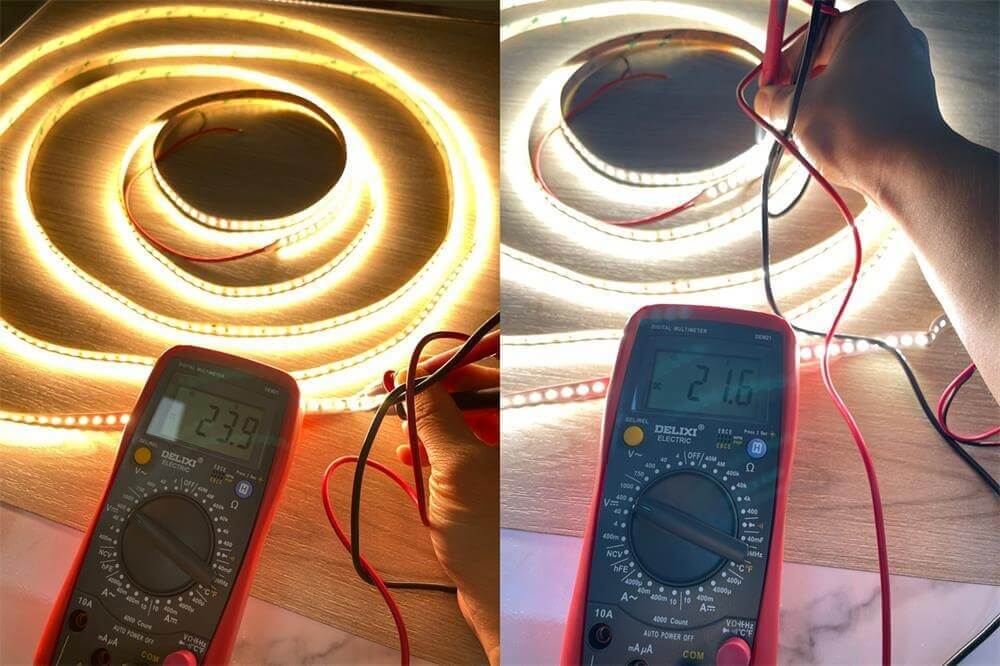
Both 12V and 24V LED strips have maximum run times; 24V strips typically last longer. You can power the 24V 2835 120LED 9.6W LED strip from just one side for use up to 7 meters long run times; for 12V strips, however, we only recommend lengths up to 5 meters long. For even longer runs, read our Leitfaden zum Spannungsabfall.
4. Luminous Efficiency
Both 12V and 24-volt LED strips are energy-saving devices with low voltage consumption; the 24-volt strip being slightly more effective at producing light output. LED strips like any electronic circuit produce heat and resistance; 12V strips produce more heat, drawing a greater current from their power supply, leading to reduced luminous efficiency due to wasted energy.
5. Brightness
The 24-volt strip can produce slightly brighter light output, though any differences may be difficult to notice by the naked eye. When it comes to accent and mood lighting, linear 24-volt light strips may be your best bet. If industrial signage and lighting needs arise, linear illumination is usually best served with 24-volt strips.

6. Cut Unit
In general, 24V strips should be cut every six or seven LEDs, while 12V strips may be cut at three LEDs. The cuttable length of 24V LED strips is half that of 12V ones; for the 2835 120 LEDs per meter strip in 12V mode, this corresponds to a 25mm cutting interval and 50mm in 24V mode respectively.

12V strips make an excellent lighting solution for projects with tight corners that need illumination. Since they can be cut to any length you require, 12V strips offer versatility that few other products can match. Learn how in our Schnittführung.
7. Application Range
12V
A 12V power source is ideal for smaller applications, including cars and boats powered by 12V batteries. They are flexible and their cuttable lengths are shorter compared with 24V systems.
24V
24V can be an ideal solution when running longer strips or high-lumen output lights, as they work well on surfaces that do not require tight spaces.
Most electrical systems rely on 12V DC supplies, due to their widespread usage in lighting projects at bars, restaurants and hotels, etc. 24V is typically employed when available as well.
8. Power Supply
To keep both 12V and 24-volt designs operational, they require power supplies of various kinds — these options can be found online as well as locally. See our LED power supply guide for sizing and selection.

9. Häufige Fragen und ihre Antworten (FAQs)
▶Funktionieren 12-V- und 24-V-Lichtbänder zusammen?
Nein. Ein 12-V-LED-Streifen leuchtet nicht, wenn ein 24-V-LED-Streifen an Ihr Projekt angeschlossen ist. Wenn RGB-LED-Streifen miteinander verbunden sind, kann ein schwaches rotes Leuchten auftreten. 12-V-Streifen, die an 24-V-Stromquellen angeschlossen sind, werden noch gefährlicher, da sie innerhalb von Sekunden überhitzen und möglicherweise sogar zu Brandgefahr führen können, wenn sie zu lange angeschlossen bleiben.
▶Hat der 12-V-Streifen eine höhere Sicherheitsbewertung als der 24-V-Streifen?
Beide Nennwerte sind relativ niedrige Spannungswerte und unterscheiden sich daher kaum in ihrer Sicherheitsbewertung. Wie bereits erwähnt, kann der Spannungsabfall eine wichtige Rolle spielen – Systeme mit niedrigerer Spannung führen zu mehr Verlusten, daher ist es wahrscheinlicher, dass es bei 12-Volt-Systemen zu Spannungseinbrüchen kommt.
▶Kann ein 24-V-LED-Streifen mit 12-V-Spannung betrieben werden?
Um einen 24-Volt-Streifen an eine 12-Volt-Stromquelle anzuschließen, kann ein Transformator oder eine Spannungserhöhung erforderlich sein, da 24-V-Streifen aus mehreren Reihen von 6 LEDs bestehen, die nicht zerlegt werden können, um an 12-V-Quellen angeschlossen zu werden.
▶Kann ein 12-V-LED-Streifen mit 24 V betrieben werden?
Leider nicht, da eine 12-V-Streifenleiste durch Überspannung beschädigt und zerstört wird, wenn sie mit einer 24-V-Stromquelle betrieben wird.
▶Welches LED-Streifendesign ist besser: 12V oder 24V?
Dies hängt ganz von Ihrer Anwendung ab; Nachdem Sie nun sowohl die Vor- als auch die Nachteile verstanden haben, können 24 V geeignet sein, wenn die Schnittlänge keine Rolle spielt. Aus Platzgründen wären 12V empfehlenswerter.
Letzte Gedanken
There are a few differences between 12V and 24V LED strips; both can serve many functions and applications. A good lighting plan will assist in making informed decisions when purchasing these lighting strips. KayTai offers premium LED strip lights at competitive prices. We have been providing premium lighting products for many years. As one of the premier LED manufacturers, we guarantee 100% customer satisfaction with every order placed with us.
12V or 24V? Let Us Help You Decide
Tell us your project length and application, and our team will recommend the right voltage with factory-direct pricing and free samples.
Kontaktieren Sie KayTai
Voltage choice depends on run length and this guide explains it well. 24V wins on longer runs with less drop, while 12V suits short simple setups. Practical comparison.