
Two white lights can look identical in a photo — and completely different in a room. One makes skin look healthy and food appetizing; the other makes everything look flat and dull.
The difference comes down to two numbers: color temperature (CCT) dan color rendering (CRI). This guide explains both — and shows why they matter for every LED strip purchase.
01 Why Color Quality Matters
Light is not just about brightness. Two lights with the same lumen output can feel completely different because of their tone (warm vs cool) and their ability to show true colors.
Warm light relaxes, cool light energizes
The same room feels cozy or clinical depending on color temperature.
Colors should look real
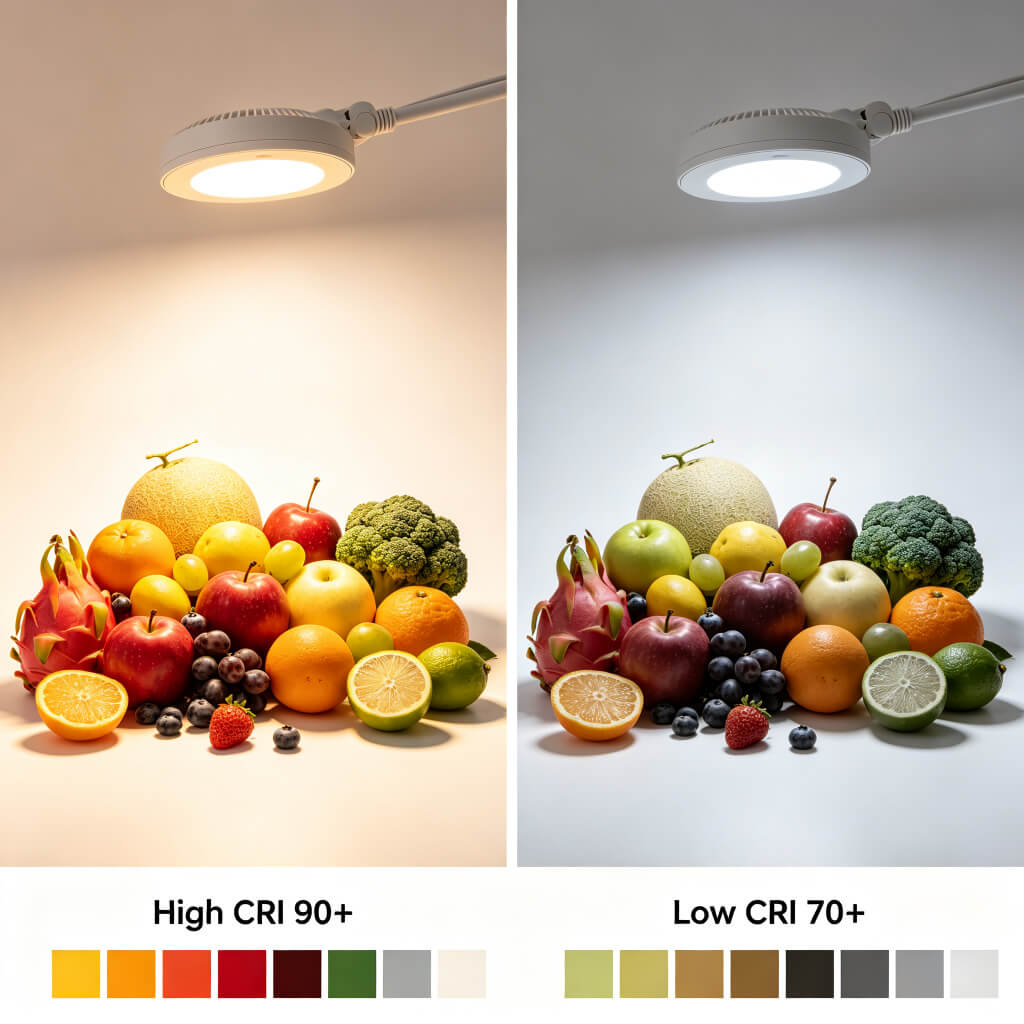
Under good light, a red apple looks red. Under poor light, everything looks gray.
Consistency across one installation
Strip after strip should match — or the whole ceiling looks patchy.
Quality shows
High-CRI, consistent LEDs cost more — and are worth it for retail, hospitality, and homes.
02 Color Temperature Explained
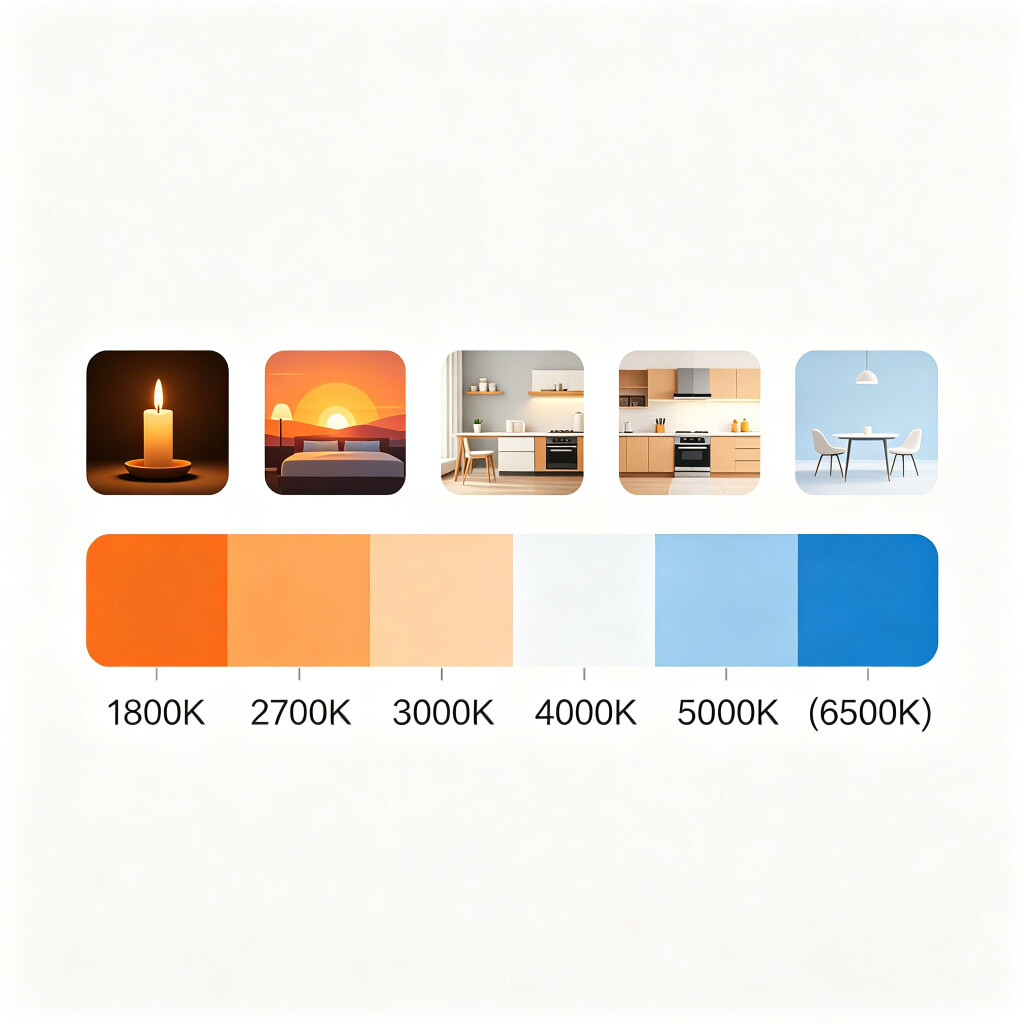
Color temperature (CCT) describes whether light looks warm (orange) or cool (blue), measured in Kelvin (K). It is based on the color a “black body” glows at a given temperature.
The CCT Scale
- 1800–2700K — warm, candle-like glow (bedrooms, hotels, restaurants)
- 3000–4000K — neutral white (kitchens, living rooms, offices)
- 5000–6500K — cool daylight (garages, workshops, retail, task areas)
Modern LED strips can be tuned across this range — or even built as putih boleh laras so you can shift CCT throughout the day.

Why “White” Is Not One Color
Incandescent bulbs automatically landed around 2700K. Fluorescents often leaned cool and greenish. LEDs can hit any CCT precisely — which is why choosing the right Kelvin matters more than ever.
Compare every option in our guide to 2700K lwn 3000K lwn 5000K lwn 6500K.
03 CCT & Duv: Getting It Right
CCT alone does not fully describe a white light. Two 3000K lights can still look slightly green or pink. That difference is measured by Duv (Delta u,v).
Putih Neutral
Exactly on the black-body line — the reference “true” white. This is what quality brands target.
Greenish Tint
Light sits above the black-body line and can look greenish. Common in cheap LEDs.
Pinkish Tint
Light sits below the line and can look pink or magenta.
Specify 0 Duv
When buying strips, look for products binned to a Duv of 0 (or within ±0.002) for neutral, natural white.
Duv is why two “3000K” strips from different brands can look different side by side — the CCT is the same, but the tint differs.
04 CRI: Color Rendering Index
CRI (Color Rendering Index) measures how accurately a light reveals true colors, from 0 to 100. A CRI of 100 equals sunlight or an ideal incandescent.
What the Numbers Mean
- CRI 90+ — excellent color, ideal for retail, photography, makeup, and homes
- CRI 80–89 — good for general commercial use
- CRI < 80 — poor color rendering, best avoided for most indoor uses
The standard CRI (Ra) averages rendering on 8 color samples (R1–R8). R9, the deep-red sample, is separately important — many LEDs score low on R9 even with a high Ra.
05 Beyond CRI: TM-30 & SPD
CRI has limits — it uses only 8 pastel samples and can miss problems. Modern standards give a fuller picture:
Modern Standard
Uses 99 real color samples. Rf (fidelity, like CRI) and Rg (gamut, saturation) plus a color vector graphic.
Spectral Power Distribution
Shows the exact spectrum of the light. Sunlight is a smooth curve; some LEDs show sharp spikes and dips.
Deep Red Rendering
Checks saturated red — critical for food, skin tones, and retail displays. High R9 (>50) is a premium feature.
A high-CRI LED with a fuller SPD renders colors more naturally — which is why KayTai’s high-CRI strips (Ra 90+) are so popular for makeup mirrors, retail, and hospitality.
06 Color Consistency & Binning
Color quality is not just about one strip — it is about every strip matching the next. That is controlled by binning and measured by SDCM.
SDCM / MacAdam Ellipses
- 1–2 SDCM — color difference invisible to the human eye (premium)
- 3 SDCM — difference only visible to trained observers
- 5 SDCM — noticeable difference, typical of budget LEDs
- 7 SDCM — clearly visible mismatch between strips
Quality strips are binned to ≤3 SDCM, and the best to ≤2 SDCM, so your whole installation looks uniform.
How Binning Works
This is why consistency varies between brands. Learn more in our guide to Konsistensi warna LED.
07 Choosing CCT & CRI for Your Project
Here is a practical decision guide:
| Application | CCT yang disyorkan | Recommended CRI |
|---|---|---|
| Bedroom / Hotel | 2700 – 3000K | 90+ |
| Living Room | 3000 – 3500K | 90+ |
| Kitchen | 3500 – 4000K | 90+ |
| Bathroom / Makeup | 4000 – 5000K | 90+ (high R9) |
| Office / Study | 4000 – 5000K | 85+ |
| Retail Display | 3000 – 4000K | 90+ (high R9) |
| Garage / Workshop | 5000 – 6500K | 80+ |
| Photography / Video | 5000K daylight | 95+ |
Terokai kami jalur putih boleh melaras for adjustable CCT, and our high-CRI single-color strips for precise fixed tones.
08 Color & CRI FAQ
S1What CRI should I look for in LED strips?
For homes, retail, and hospitality, choose CRI 90+. For critical color work — makeup, photography, art — look for CRI 95+ with a high R9.
S2What is the best color temperature for a bedroom?
Warm white around 2700–3000K. It is relaxing, flattering to skin, and supports your body’s natural wind-down in the evening. See our panduan suhu warna.
S3Why do my two LED strips look different colors?
Likely binning. If strips are binned to different SDCM steps (e.g. 5 or 7), colors can visibly differ. Buy strips binned to ≤3 SDCM for a uniform look.
S4What is the difference between CCT and CRI?
CCT is the tone of the light (warm vs cool, in Kelvin). CRI is how accurately it reveals true colors. A light can be cool (5000K) and still render colors poorly (low CRI) — the two are independent.
Get Consistent, High-CRI LED Strips
Ask our team about our binned high-CRI strips and request samples before you order.

This color temperature guide is very practical. The Kelvin scale explanation with example applications makes it easy to spec lighting for different rooms. The CRI section cleared up a few misconceptions I had.
Useful reference for choosing color temperatures. The comparison of warm vs cool light for different spaces is exactly the kind of guidance non-professionals need. The CRI vs color temperature distinction is well explained.
The CRI explanation with the 80 vs 90 comparison helped me justify the upgrade cost to a client. The colour temperature table for different rooms is now a quick reference I keep open during every kitchen project.