
Consistența culorii benzilor LED explicată: CCT, Binning și MacAdam
You ordered 3000K LED strips, and the whole room looks warm and even — until you join two reels and notice one side looks slightly pinker than the other. That is a color consistency problem. In LED lighting, color consistency defines the quality of the light: it is what makes a large installation look like one continuous piece of light instead of a patchwork of mismatched sections. In this guide we explain CCT, LED binning and the MacAdam ellipse — and how KayTai keeps color uniform from one reel to the next.

Cuprins
What Is CCT (Correlated Color Temperature)?
CCT, or Correlated Color Temperature, is the number that describes whether white light looks warm, neutral or cool. It is measured in kelvin (K):
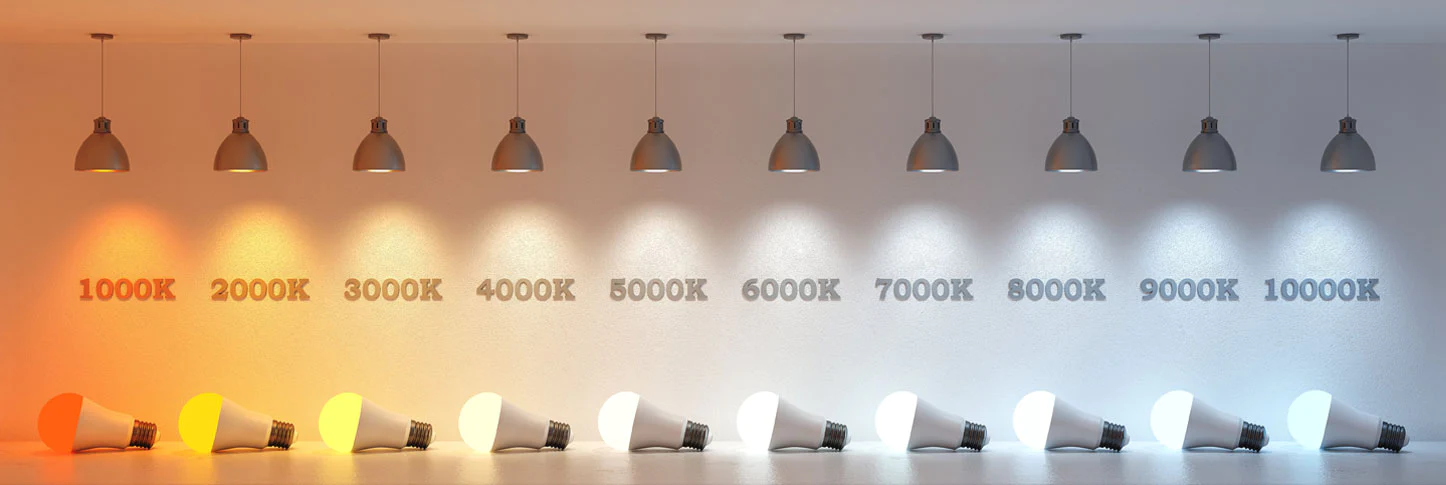
2700K
Warm white — cozy, hotel-like, ideal for bedrooms and living rooms.
3000K
Warm white — soft and inviting, great for kitchens, dining and retail.
4000K
Neutral white — clean and bright, popular for offices, bathrooms and workshops.
5000–6500K
Cool white — crisp and bright, used for task lighting, garages and showrooms.
The same CCT value can still look different from one manufacturer to another, or even from one batch to the next. That is why manufacturers use strict controls to keep the actual color close to the target — see our full comparison in the LED color temperature guide.
Why Color Consistency Matters
In a single small lamp, a slight color shift is hard to notice. In LED strip installations it becomes impossible to ignore, because strips are usually installed in long continuous runs. Color consistency matters most in these situations:
Long Continuous Runs
Cove lighting, ceiling lines and under-cabinet runs can stretch for meters. At every join, even a small color difference is clearly visible.
Multiple Reels in One Project
A room often needs several reels joined together. If the reels come from different batches with different color bins, the wall shows visible patches.
Reorder & Restock
You may install 50 reels this year and need 20 more next year. Without batch control, the new reels may not match the old installation.
Brand & Retail Spaces
Hotels, showrooms and retail stores want every room to look identical. Color mismatch damages the premium feel of the space.
If the strip runs inside an aluminum profile, the diffuser spreads the light — but it does not hide color differences between sections. Choosing the right profile still matters for the finish; see our LED profile buying guide.
How Color Consistency Problems Become Apparent
Color problems rarely show in a single photo. They appear over time and over distance, in ways that are hard to fix once installed. Here is where they usually show up:
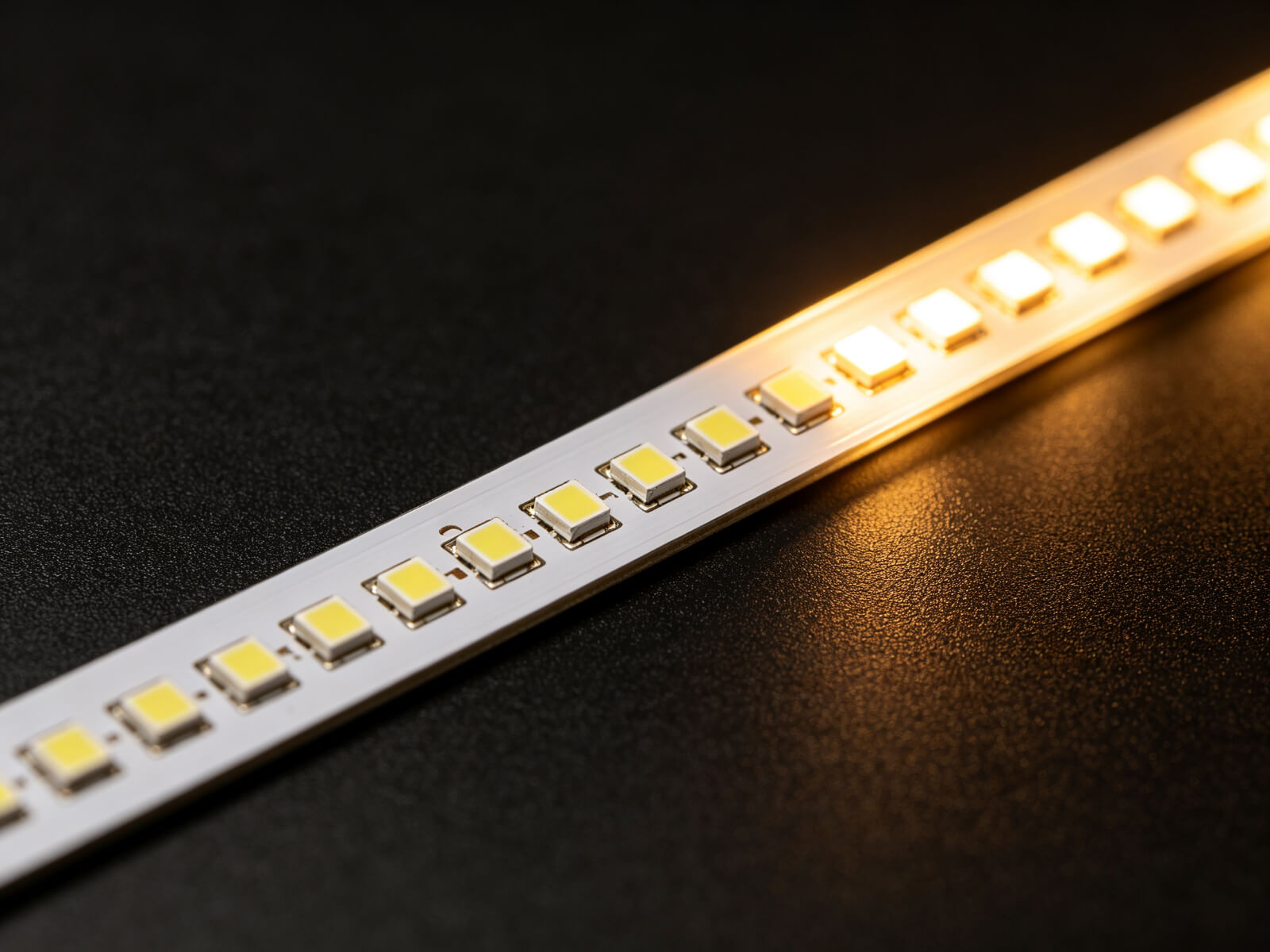
01. Different Batches
LED chips change between supplier batches. If a factory does not control bins, two orders of the same 3000K strip can look warm vs cool side by side.
02. Within One Reel
Poor soldering or uneven current can make one end of a reel dimmer or slightly different in color, visible over a long 5m run.
03. After Long Use
Low-grade chips and weak heat management cause uneven light decay — some sections fade and shift color faster than others.
04. After Waterproofing
Low-quality glue or resin can yellow over time and shift the perceived color temperature of the strip.
What Is LED Binning?
LED chips are not identical, even when they come from the same production line. Tiny variations in the manufacturing process mean each chip emits a slightly different brightness and color. Binning is the process of measuring every chip and sorting it into groups (“bins”) with similar brightness and color. Strips built from chips in the same bin look consistent; strips built from mixed bins do not.
How binning looks in practice: the six blocks below are all labelled the same CCT, but each falls in a different bin. Installed together, their difference is easy to see.
A responsible manufacturer sorts chips by both brightness and chromaticity before production, and keeps the strip’s target bin documented. At KayTai we use strict quality control and single-bin selection so the reel you receive is uniform — and matches the reel you reorder later.
What Is the MacAdam Ellipse?
The MacAdam ellipse is a scientific way to describe how far a color can drift before a human eye notices the difference. It is drawn around a target color on a chromaticity diagram; the smaller the ellipse, the closer the actual color stays to the target.
The center dot is the target color. Smaller ellipses = tighter color control = less visible difference.
3-Step MacAdam
Very tight control. The difference is almost impossible to see with the naked eye — the standard for premium cove lighting, hotels and long retail runs.
5-Step MacAdam
The common quality standard for most commercial projects. Differences are barely visible in typical installations.
7-Step MacAdam
A looser standard. Differences may be noticeable when strips are joined side by side in long runs.
For LED strips that will be installed in long visible runs, ask for tighter binning — it is one of the details that separates premium strips from budget strips.
How KayTai Ensures Color Consistency
We go beyond the industry standard to keep our strips uniform — from the chip to the finished reel. Here is what we do:
Single-BIN Chip Selection
Chips are sorted into tight brightness and color bins before production, so every LED on the reel is a close match.
Integrating-Sphere Measurement
Spectral parameters are measured precisely during packaging, catching drift before it reaches the strip.
Batch & Reel Records
Every reel records its production batch and bin. We can match reels and support your future reorders.
100% Final Check
Each reel is inspected for consistent color and brightness before it is packed.
Consistent Components
Quality chips, proper current control and good heat management keep color stable over the strip’s lifetime.
Color Consistency Across Range
The same control applies to our tunable white, RGBW şi single color strips.
Consistency is also about how you install and power the strip. For long runs, correct voltage management and a quality alimentare electrică keep brightness even from the first meter to the last.
FAQ
▶What CCT should I choose for my room?
2700–3000K gives a warm, cozy feel for bedrooms and living rooms; 4000K is clean and bright for kitchens and offices; 5000–6500K suits task and display lighting.
▶What does 3-step vs 5-step MacAdam mean?
It describes how tightly the color is controlled around the target. 3-step is nearly invisible to the eye and ideal for long continuous runs; 5-step is the common standard for most projects.
▶Why do two reels of the same 3000K strip look different?
They may come from different color bins or production batches. Choose a supplier that uses single-bin selection and keeps batch records, so reels match now and when you reorder later.
▶Can KayTai match color when I reorder in the future?
We keep batch and bin records for every reel. Tell us the previous order and we will match the color as closely as possible.
▶Do RGB strips have color consistency issues too?
Yes. Color consistency also matters for RGB and tunable white strips. We apply the same binning and inspection control across the whole range.
Need Consistent Color for Your Project?
Talk to our team about CCT, binning and batch matching — we’ll help you choose strips that stay uniform across your whole installation. Free samples available.
Contactați KayTai
1 gândit la „Consistența culorii benzilor LED explicată: CCT, Binning și MacAdam”