
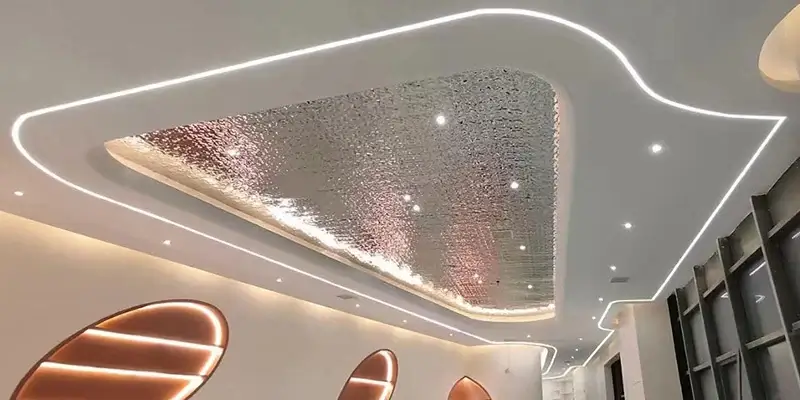
ஏ flexible LED aluminum channel (also called a bendable LED aluminum profile or curved LED track) is the key to creating smooth, continuous light lines on curved ceilings, arched walls, circular staircases and rounded corners. Unlike rigid U-shaped channels, flexible profiles are pre-cut or engineered to bend in a controlled plane, so you can follow almost any architectural curve without gaps or visible joints.
In this guide we cover what flexible channels are made of, how LR Series மற்றும் UD Series bending directions differ, the minimum bending radius you must respect, how to bend and install the channel correctly, the best application ideas, and the mistakes that ruin curved lighting projects. If you are planning cove lighting, drywall grooves, curved step lighting or arch lighting, this article tells you everything you need before you order.
பொருளடக்கம்
- What Is a Flexible LED Aluminum Channel?
- Flexible Aluminum vs. Flexible Silicone Channel
- LR Series vs. UD Series: Two Ways to Bend
- Bending Radius: The Limit You Need to Know
- How to Bend a Flexible LED Aluminum Channel
- How to Install LED Strip in a Flexible Channel
- 7 Best Applications for Flexible LED Channels
- Common Mistakes and How to Avoid Them
- How to Choose the Right Flexible Channel
What Is a Flexible LED Aluminum Channel?
A flexible LED aluminum channel is a U-shaped or plaster-in track made from 6063-T5 aluminum alloy with a bendable PC (polycarbonate) or silicone diffuser cover. The aluminum body provides heat dissipation and mechanical protection, while the flexible diffuser spreads the LED light evenly and softens the beam. Because the channel can be bent to match a curve, it turns ordinary LED strips into architectural accent lighting.
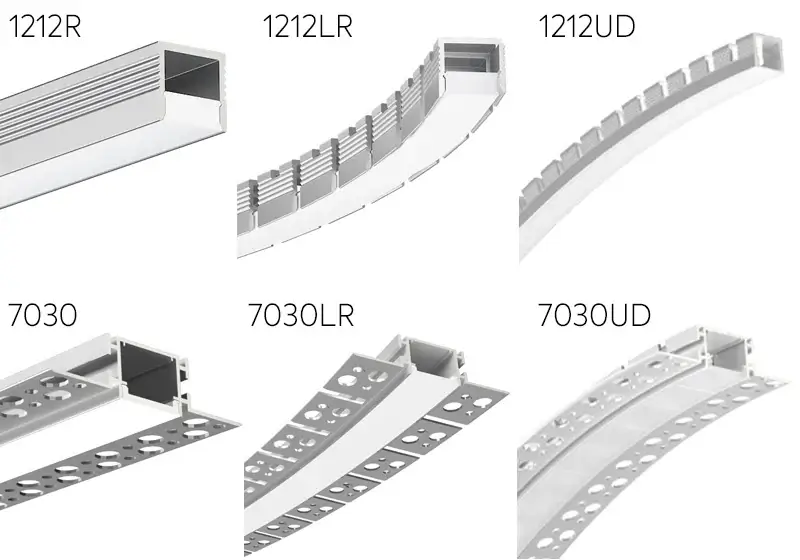
Flexible channels are usually produced from standard rigid channels by cutting the side walls at intervals, or by using an open-slot design that allows controlled bending. Common series include the 1212 recessed type for drywall and ceilings, and the 7030 type for plaster-in installation. For an introduction to standard (non-bendable) channels, see our guide on how to install LED channel in drywall.
Flexible Aluminum vs. Flexible Silicone Channel
Before choosing a flexible channel, buyers often ask whether they should use a bendable aluminum profile or a flexible silicone (food-grade) channel. Both can follow curves, but they suit different jobs. The table below compares the two at a glance.
| Feature | Flexible Aluminum Channel | Flexible Silicone Channel |
|---|---|---|
| Material | 6063-T5 aluminum body + PC/silicone diffuser | Food-grade silicone, fully flexible |
| Bendability | Medium; bend in a controlled plane, min radius depends on model | Very high; can bend freely in most directions |
| Waterproofing | No (IP20 body; use IP67/68 strip + sealed ends in wet areas) | Yes, suitable for indoor & outdoor |
| Heat dissipation | Excellent (aluminum acts as heatsink) | Poor (silicone traps heat) |
| Mechanical protection | High; rigid walls protect PCB | Medium; soft body |
| வெட்டுதல் | Yes, with hacksaw/miter saw + deburring | Yes, with scissors/knife |
| Typical length | 1 m / 2 m / 3 m | 1 m to 5 m continuous |
| சிறந்தது | Curved drywall, ceilings, steps, corners, cove lighting | Wet areas, quick DIY, outdoor decoration |
Bottom line: choose a flexible aluminum channel when you need a crisp architectural light line with good heat management; choose silicone when the installation is outdoors, wet, or needs extreme flexibility. For kitchen and cabinet scenes, you may also like our LED strip lighting ideas for the bedroom for inspiration.
LR Series vs. UD Series: Two Ways to Bend
The most confusing part of flexible channels is the bending direction. Different series bend in different planes, and choosing the wrong one is the #1 reason projects fail.
| Series | Bending direction | Typical applications |
|---|---|---|
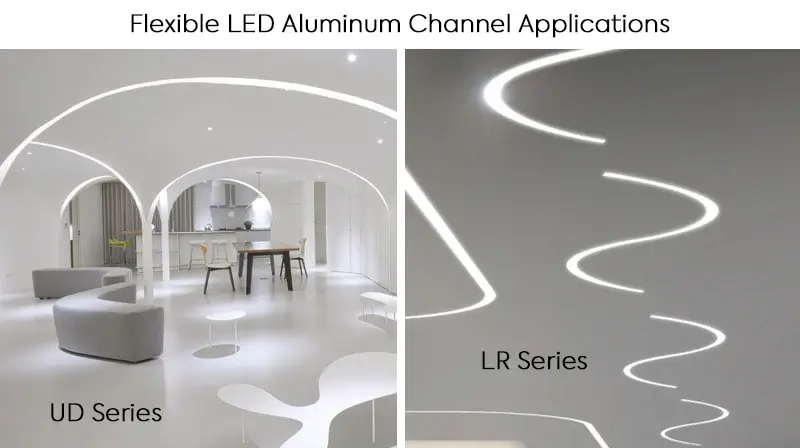
| LR Series (left–right) | Bends within the same horizontal plane, like a serpentine on a flat ceiling | Circular ceiling rings, curved wall washing, stair step outlines, serpentine ceiling lines |
| UD Series (up–down) | Bends inward/outward around the light-emitting surface | Arched passageways, curved waistlines on walls, curved ceiling–wall transitions |
Quick rule: if the surface is flat but the light line must follow a curve on it (circle, S-shape, wave), you need an LR series profile. If the surface itself is curved in cross-section (a barrel ceiling, an arch), you need a UD series profile. Also confirm the horizontal/vertical bending plane with your supplier before ordering — some profiles bend on top, others on the side.
Bending Radius: The Limit You Need to Know
Bending radius is where curved ceiling projects succeed or fail. Every flexible channel has a minimum radius; bend it tighter and the aluminum will twist or kink, the diffuser will pop out, and the LED strip can detach. Always plan the curve with the inner radius of the circle, not the outer diameter.
| Curve size | Typical minimum bend diameter | What to use |
|---|---|---|
| Large curves (radius ≥ 1 m) | 1,000 mm+ (D1000) | Standard 6063-T5 channel usually fine |
| Medium curves | 300–800 mm diameter | Flexible LR/UD series, cold-bend by hand or template |
| Tight curves | 100–150 mm radius | Dedicated bendable profiles; check spec sheet min radius |
| Under ~50 cm radius | < 100 mm (kink risk) | Use flexible silicone channel or machine bending |
Most flexible LED channel models list a minimum bending diameter of 100 mm to 1,000 mm. If the required radius is smaller than the specification, the profile may twist, the diffuser slot may deform, or the channel may crack at the cut points. Show the curve drawing or a 1:1 template to your supplier so they can confirm the right series before you buy.
How to Bend a Flexible LED Aluminum Channel
Bending is easy if you work step by step and never force the profile. Here is the installation sequence that professional installers follow.
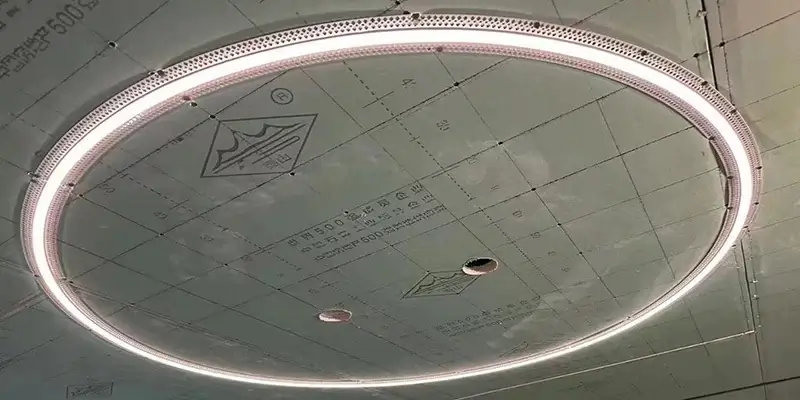
Mark the curve
Draw the exact curve on the ceiling or wall, or make a full-size template. Use the template to check the radius against the channel spec before cutting.
Cut to length with a fine-tooth saw
Cut the channel and diffuser with a fine-toothed hacksaw or miter saw. Deburr sharp edges so they do not damage the LED strip or the diffuser.
Pre-bend gradually
Form the curve slowly against the template, bending in small increments. Do not bend in one sharp movement — that causes kinking and diffuser pop-out.
Fit and fix in segments
Install the pre-bent channel in the groove or on the surface, fixing it segment by segment while keeping the center line aligned with your marks.
For plaster-in (skimming) work, protect the channel body and the diffuser groove with tape or a filler guard while plastering, so the slot stays clean for the diffuser to click back in. See our guide to plaster-in LED profiles for the full skim-coat workflow.
How to Install LED Strip in a Flexible Channel
Once the channel is bent and fixed, installing the strip is straightforward — but there is one important difference between LR and UD series.
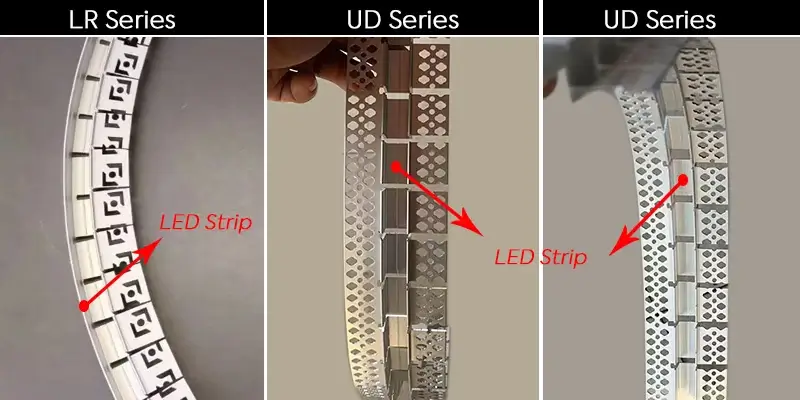
✓ For LR (serpentine) curves
When the channel bends left and right on a flat plane, the strip on the bottom can crease. Use a flexible S-shaped PCB strip, or stick the strip to the inner side wall of the channel — and check the inner width so the strip and wires fit.
✓ For UD (arch) curves
The strip lies flat on the bottom of the channel with no special requirement. Peel the adhesive backing and press the strip in, keeping it straight along the curve.
Remember that standard LED tape bends better along its length than across its width. For side-bending curves, choose a strip with a PCB layout designed for lateral bending. And in wet areas (bathroom, outdoor arch), the aluminum channel itself is not waterproof — use an IP67/68 waterproof strip plus sealed end caps and sealed wire entries. If you need to size your driver for a long curved run, use our LED மின்னழுத்த வீழ்ச்சி கால்குலேட்டர்.
7 Best Applications for Flexible LED Channels
Flexible channels turn curved architecture into glowing design. These are the applications customers ask about most, with images from real installations.


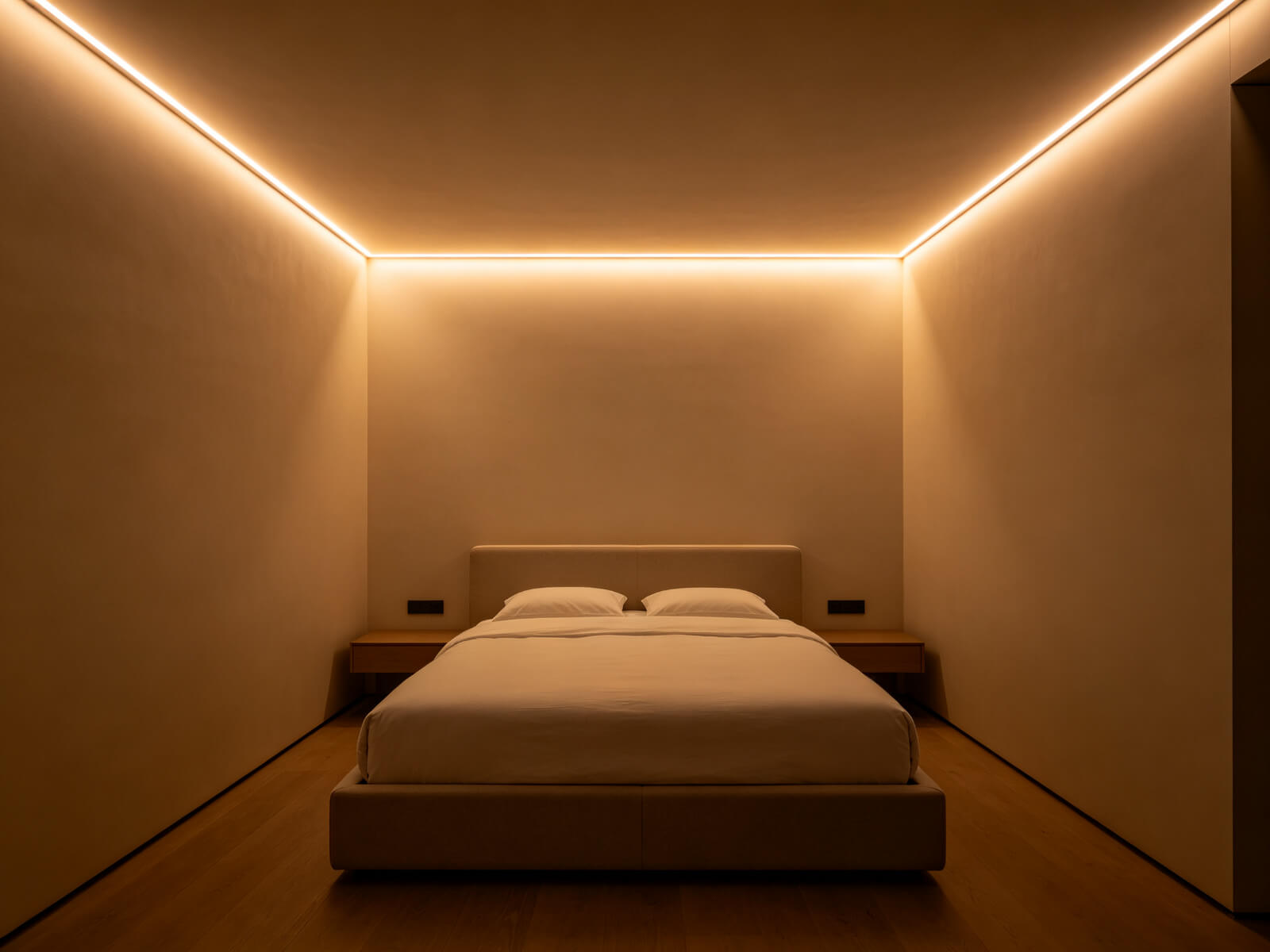

Flexible channels are also popular for indoor wall washing: a curved light line grazing a curved wall surface creates a soft, even gradient. For straight under-counter and skirting runs, see our LED skirting line lighting guide.
Common Mistakes and How to Avoid Them
These are the failures installers hit most often with flexible channels — and the simple way to prevent each one.
| Mistake | What happens | How to avoid it |
|---|---|---|
| Radius too tight | Channel twists, diffuser pops out, strip detaches | Check min radius on the spec sheet; use template before cutting |
| Wrong bending plane | Profile kinks or cracks when forced the wrong way | Confirm LR vs UD and horizontal/vertical plane with supplier |
| Strip creases in LR runs | LEDs lift or flicker at the bend | Use S-shaped PCB strip or mount on the inner side wall |
| Plaster fills the diffuser slot | Diffuser cannot click back in; light line uneven | Tape/guard the slot during skim coating |
| No waterproofing in wet areas | Strip fails; aluminum body not IP-rated | Use IP67/68 strip, sealed end caps and sealed wire entries |
| One sharp bend instead of gradual forming | Kink at the bend point, uneven light | Bend in small increments against the template |
How to Choose the Right Flexible Channel
Use this short checklist when talking to a supplier or reviewing a product page, so you order the right series the first time.
✓ Measure the curve first
Get the inner radius and total length. Match them to the channel’s minimum bend diameter and available lengths (1/2/3 m).
✓ Choose LR or UD
Flat-surface curve = LR. Cross-section curve / arch = UD. When unsure, send the drawing or a template photo to the supplier.
✓ Match strip width & type
Confirm the channel’s inner width fits your strip (e.g. 8 mm or 10 mm) and choose S-PCB strips for serpentine runs.
✓ Plan driver placement & wiring
Route cables before fixing the channel, keep the driver accessible, and check voltage drop on long runs.
Browse our full range of LED அலுமினிய சுயவிவரங்கள் — including drywall channels, recessed channels and architectural linear profiles — or read the baseboard LED channel guide if you are lighting skirting lines with straight runs.
Recommended LED Aluminum Profiles
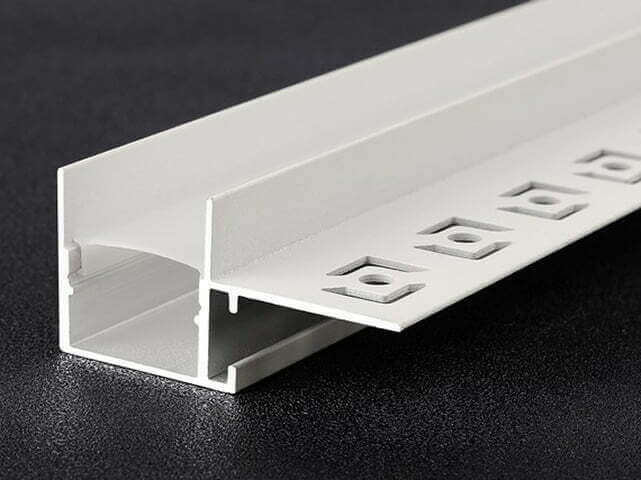
The flexible series above bends to match your curve; for straight runs in the same project, pair it with these factory-direct KayTai aluminum profiles.


Flexible LED Aluminum Channel FAQ
▶Can I bend a standard LED aluminum channel myself?
Standard rigid channels are not designed for bending — they will kink or crack. Use a dedicated flexible/bendable channel (LR or UD series) whose minimum bending radius matches your curve.
▶What is the difference between LR and UD flexible channels?
LR (left–right) series bends within the same horizontal plane, perfect for circles and serpentine lines on flat surfaces. UD (up–down) series bends inward/outward around the light-emitting surface, perfect for arches and barrel ceilings.
▶What is the minimum bending radius for flexible LED channels?
It depends on the model, typically from about 100 mm to 1,000 mm bend diameter. Always check the spec sheet and measure with the inner radius of your curve; below the minimum the channel will twist and the diffuser may pop out.
▶Can flexible aluminum channels be used in wet areas?
The aluminum channel itself is not waterproof. In wet or outdoor areas use an IP67/68 waterproof LED strip plus sealed end caps and sealed wire entries inside the channel.
▶Which LED strip works best inside a flexible channel?
Use a strip whose PCB width fits the channel’s inner slot. For LR serpentine runs choose a flexible S-shaped PCB strip or mount the strip on the inner side wall; for UD arch runs a standard flexible strip works on the bottom.
▶How long are flexible LED aluminum channels?
Flexible channels are commonly supplied in 1 m, 2 m or 3 m lengths and can be cut to size with a fine-toothed saw, then deburred before bending.
▶Is a flexible aluminum channel better than silicone?
For architectural interiors, aluminum gives better heat dissipation, mechanical protection and a crisper light line. Choose silicone only when you need extreme flexibility, waterproofing or outdoor use.
Planning a Curved LED Lighting Project?
Tell us your curve radius and layout — our engineers will recommend the right flexible channel series and send free samples with full installation support.
KayTai ஐ தொடர்பு கொள்ளவும்