A Professional Buyer’s Guide to LED Strip Light Price vs. Value for Money
Author: KayTai — a direct manufacturer of LED strip lights since 2011, supplying wholesalers, importers, lighting contractors and OEM/ODM partners worldwide.
Mục lục
- Introduction: Why Unit Price Alone Never Tells the Whole Story
- What Actually Drives LED Strip Light Pricing
- Price Benchmarks: Budget vs. Mid-Range vs. Premium
- How to Calculate the Real Value for Money
- Choosing the Right Strip for Your Application
- Why Professional Buyers Choose KayTai
- Frequently Asked Questions
- Phần kết luận
Introduction: Why Unit Price Alone Never Tells the Whole Story
Walk through any online marketplace and you will find LED strip lights priced from under $1/meter to over $50/meter. For professional buyers — procurement managers, electrical wholesalers, lighting installers and importers — the real question is not which strip is cheapest, but which strip delivers the lowest cost over its usable lifetime. This guide breaks down every cost driver behind LED strip pricing, benchmarks budget, mid-range and premium options, and shows you how to calculate genuine value for money before you place an order. If you are new to spec’ing strips, start with our step-by-step guide to choosing the right LED strip light or the newer Hướng dẫn mua dải đèn LED first.
1. What Actually Drives LED Strip Light Pricing
Six factors decide what you pay per meter — and six factors decide whether that price is worth it. Here is what they mean in practice.
1.1 LED Chip Grade, Size and Density
The LED chip is the single largest cost component of any strip. Chip brand, package size (2835, 5050, 2110, 2216), and density per meter all move the price. Premium chips from CREE, Osram or Nichia deliver higher luminous efficacy, tighter color consistency and slower lumen decay than generic dies. A high-density 2835 layout — for example 120 LEDs/meter — produces uniform, hotspot-free illumination, while cheaper low-density boards often show visible light pooling. To compare chip technologies properly, read our deep dive on SMD LEDs in LED strip lights and the COB vs. SMD comparison before buying.
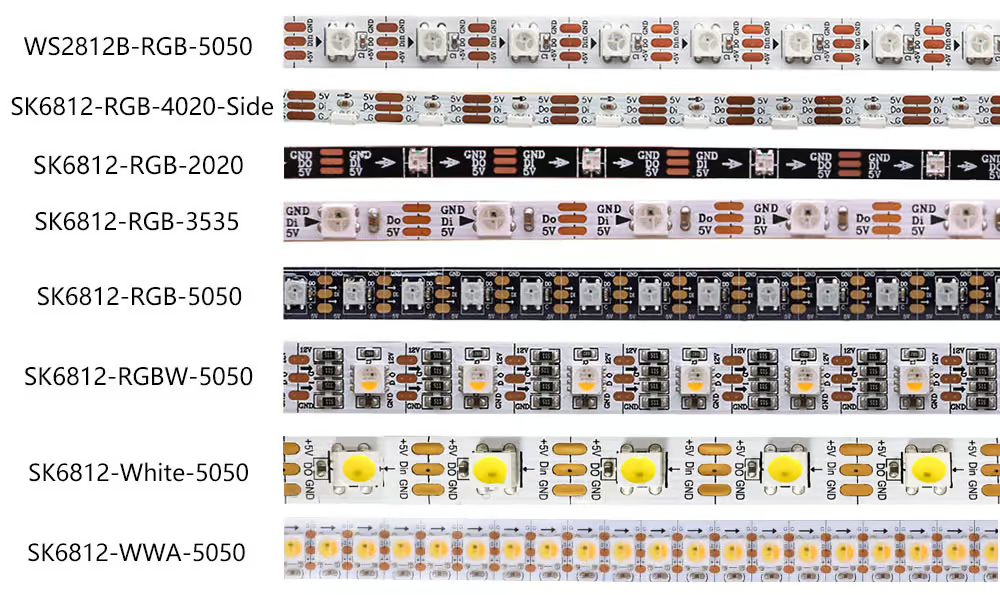
KayTai Insight: We standardize on 2835 SMD chips with CRI > 90, binned for consistent color temperature, so every production run matches the approved sample — a critical requirement for multi-project buyers.
1.2 PCB Quality and Copper Thickness
Many buyers overlook the circuit board, yet it dictates voltage drop, heat dissipation and lifespan. Standard 1oz copper foil is cheaper but struggles on runs over 5 meters; 2oz or thicker copper, wider traces and quality solder mask cost more but keep brightness consistent and prevent premature failure. For long continuous runs, this is where “cheap” strips quietly become expensive — and it is exactly where our quality system focuses its checks.
1.3 Voltage, Driver and Power Design
Operating voltage strongly influences system cost. 12V and 24V low-voltage strips are safer, easier to dim and cut to length, and pair with constant-voltage drivers; 24V is the professional default for minimizing voltage drop. 48V constant-current strips and 220V high-voltage strips suit very long runs (cove lighting, signage) with fewer power supplies but demand more careful installation. Compare 12V vs 24V systems and understand power injection and voltage drop management — essential for any professional installation over 10 meters.
1.4 Waterproofing and IP Ratings
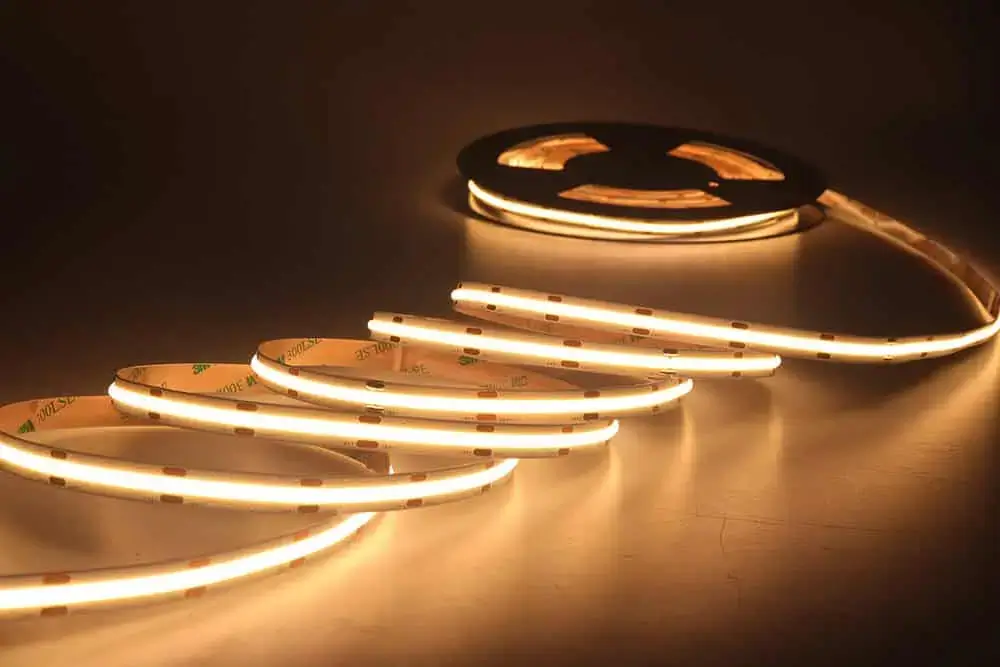
IP rating is one of the clearest price drivers. IP20 (bare) is the cheapest and is fine for dry indoor coves; IP65 silicone-coated strips resist dust and splash; IP67/IP68 options use full silicone extrusion or PU potting for outdoor and humid environments. Each protection layer adds materials and process cost — typically $5–$10/meter on top of a bare strip. For outdoor projects, pairing a genuinely IP68-rated strip with the right adhesive for waterproof LED strips determines whether it survives years of weather. Match the level to your site with our hướng dẫn dải đèn LED chống thấm nước.
1.5 Smart Control, Dimming and Addressability
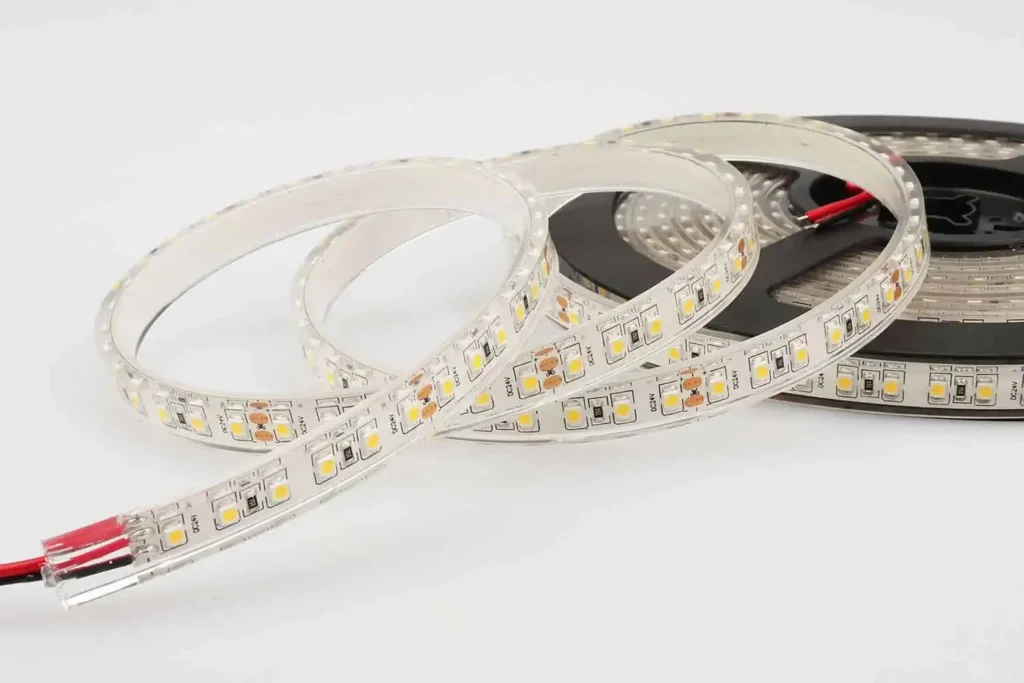
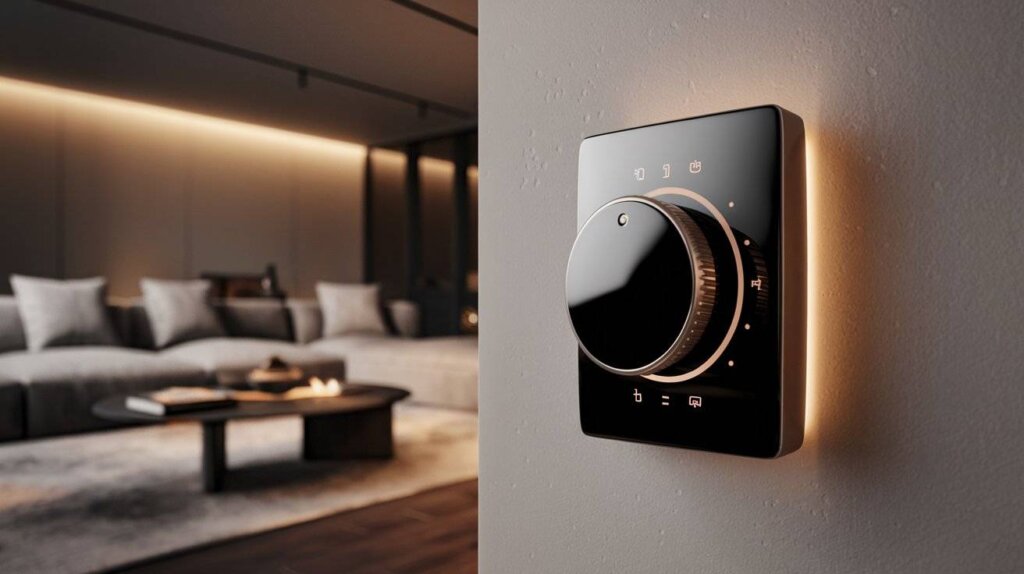
Smart features — app control, voice integration (Alexa/Google Home), DALI or 0–10V dimming, and addressable RGBIC effects — add ICs, antennas and firmware, pushing price well above static white strips. Decide early whether the project truly needs addressability or basic dimming; paying for control logic you never use is a classic value leak. A quality dimming setup like the one below can also extend lifespan by reducing thermal load.
1.6 Certifications and Compliance
For commercial and export use, certification is non-negotiable. CE, RoHS, UL/ETL and TUV marks prove the product meets electrical safety and EMC standards — and protect you from liability, customs delays and project failures. Certified strips carry a visible premium over uncertified equivalents, but for professional buyers that premium is insurance, not markup. Always request test reports and verify the certificate covers the exact SKU you are importing.
2. Price Benchmarks: Budget vs. Mid-Range vs. Premium
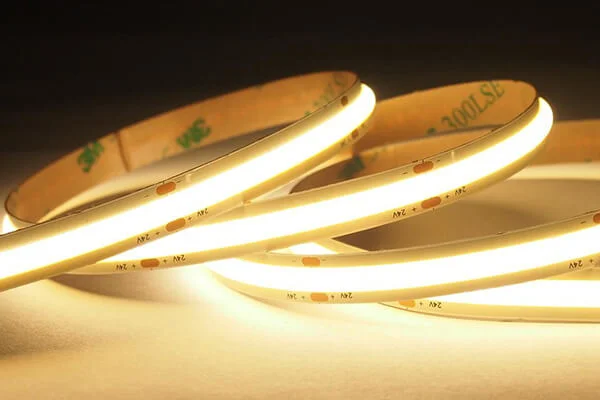
Prices vary widely, so it helps to see them in three clear brackets — and what each bracket actually buys.
2.1 Budget Strips ($3–$15/meter)
Generic and entry-level brands typically run $3–$6/meter, with low-CRI LEDs (below 80), thinner PCBs and minimal QC. They suit short-term decorative jobs where replacement cost is acceptable. Consumer smart strips sit at $12–$15/meter but are limited to roughly 800–1,000 lumens/meter and basic control. The hidden cost is inconsistency: color temperature varies between batches, which is fatal for multi-reel projects.
2.2 Mid-Range Strips ($15–$25/meter)
This bracket delivers the best balance for most professionals. Options offer 1,400 lumens/meter, CRI > 95 and a long warranty at ~$20/meter, while comparable consumer ecosystems (at $18–$30/meter) add app ecosystems and RGBIC sync. If you need consistent output across a project, compare CCT and CRI specifications rather than the sticker price.
2.3 Premium Strips ($25–$50+/meter)
Premium products — high-efficiency COB strips, industrial architectural lines, or tunable-white systems — command $25–$50+/meter for seamless diffusion, ultra-high efficacy and architectural-grade consistency. They are worth it when light quality is the deliverable (retail, hospitality, premium residential). For tunable-white projects, review the key factors when buying tunable white strips and choose color temperature by application.
See the actual range in our đèn dải LED catalog, with lõi ngô, màu đơn Và RGBW options to fit every budget.
3. How to Calculate the Real Value for Money

Unit price is only half the equation. Use these three calculations to compare strips fairly before you order.
3.1 Total Cost of Ownership (TCO)
Value = (usable light output × lifespan) ÷ total cost, including purchase, installation, replacement labor and energy. A $6/meter strip that fails in 2 years can cost more than a $20/meter strip that runs for 10. Factor in how long a strip should last before comparing unit prices — see our LED strip light lifespan guide for realistic service-life data.
3.2 Cost per 1,000 Lumens
Because brightness varies widely, normalize price by light output. Divide price per meter by lumens per meter and multiply by 1,000. A cheap 500 lm/m strip at $5/meter costs $10 per 1,000 lumens; an efficient 1,400 lm/m strip at $20/meter costs only $14.28 per 1,000 lumens but produces nearly three times the light — usually the better deal per fixture.
3.3 Energy, Maintenance and Downtime Savings
Higher-efficacy strips draw fewer watts for the same brightness, cutting energy bills over the project lifetime. For commercial sites, downtime and re-installation labor often dwarf the strip cost itself. Buying certified, binned, well-driven strips is how professional buyers protect themselves — and it is precisely why sourcing LED strip lights from a reliable China manufacturer is so common in this industry.
For more on lifespan and energy, read why you should use LED strip lights and choose the right power supply for long, reliable runs.
4. Choosing the Right Strip for Your Application
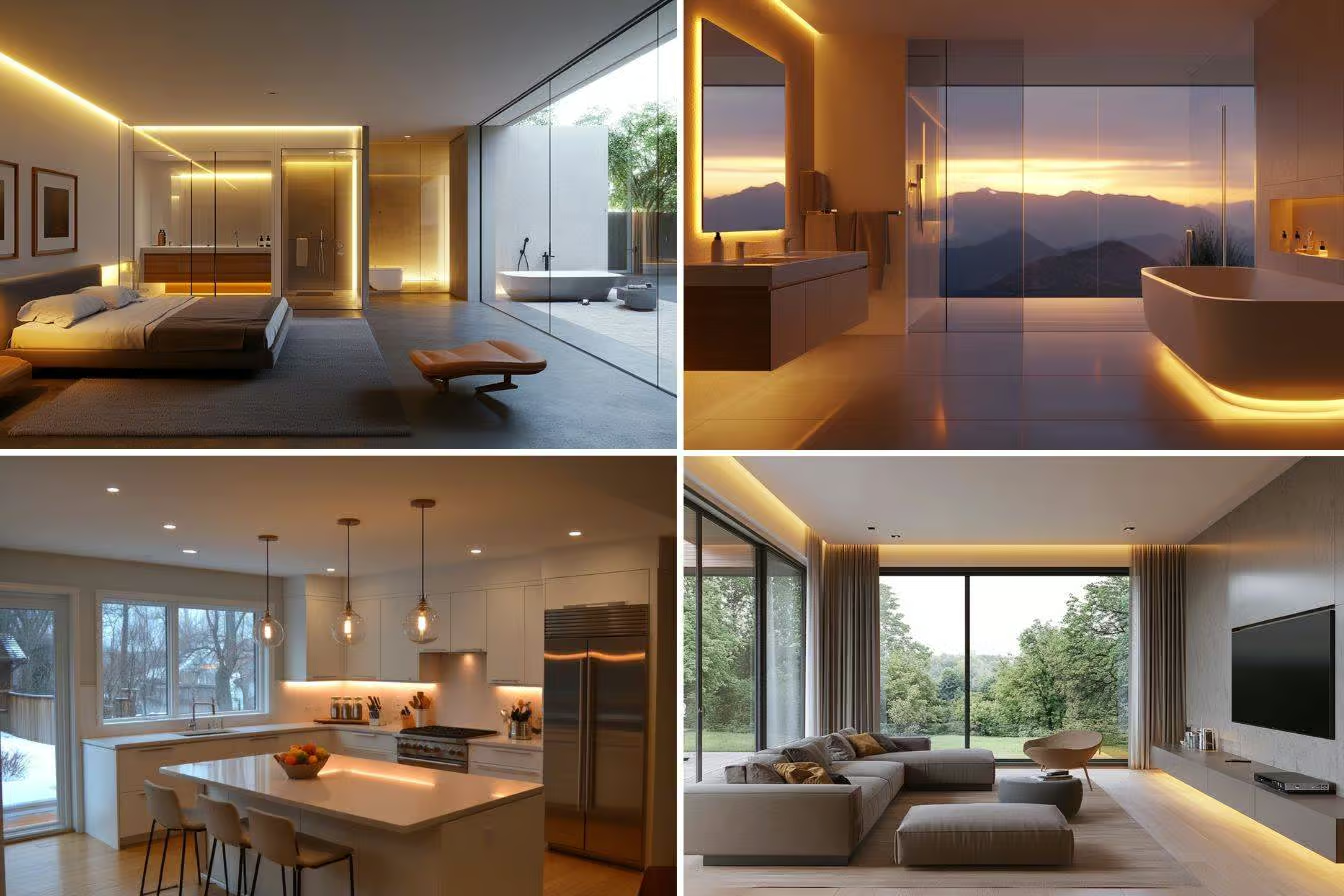
4.1 Match the Strip to the Use Case — start from the application, not the price:
Ambient / Cove Lighting
2700K–4000K, CRI > 90, dimmable drivers.
Chiếu sáng nhiệm vụ
Kitchens, workshops: high-brightness strips, 12W/meter or more.
Outdoor / Humid
IP65–IP68 with UV-resistant coating and corrosion-proof connectors.
Architectural / Retail
High-CRI COB or tunable white for accurate color rendering.
4.2 Common Buying Mistakes to Avoid — four traps that turn a “cheap” strip into an expensive one:
✕ Ignoring voltage drop
For runs over 5 meters, use 24V/48V, parallel feeds, or power injection — and plan how to connect multiple strips before ordering.
✕ Buying counterfeit or unverified stock
Always verify CE/RoHS/UL certificates against the exact SKU.
✕ Mixing color temperatures across batches
Request binned chips to keep every reel identical — see our color consistency guide.
✕ Choosing the wrong IP rating
Indoor IP20 in a bathroom will fail fast. Match the rating to the environment.
5. Why Professional Buyers Choose KayTai
KayTai is a direct LED strip manufacturer, not a reseller. That means factory-direct pricing with no middleman markup, OEM/ODM customization (lengths, color temperature, PCB layout, connectors), and rigorous QC — see how we manufacture LED strips and the quality system behind every reel. Our facility is certified for CE and RoHS, and our support team works with importers and contractors on packaging, labeling and shipping documentation. See why buyers source color LED strips from China, the business case for direct sourcing, and how custom OEM/ODM projects work.
6. Frequently Asked Questions
▶Are more expensive LED strip lights worth it?
Usually, yes — for professional use. Higher prices typically buy better chips, thicker PCBs, proper drivers, certification and warranty, which lower the total cost of ownership. The exceptions are budget projects with a short service life, where a cheap strip is acceptable.
▶How much should LED strip lights cost per meter?
Expect roughly $3–$6/meter for basic indoor budget strips, $15–$25/meter for professional-grade mid-range, and $25–$50+/meter for premium COB, tunable-white or architectural products. Price depends on chip density, CRI, IP rating and certification.
▶Why are some LED strips so cheap?
Cheap strips typically use low-grade chips, thin copper PCBs, no certification, and minimal QC. They suffer from color inconsistency, early dimming and short lifespans — which is why the unit price is low but the true cost is high.
▶What is the most cost-effective LED strip?
For most projects, a 24V, 2835 high-density strip with CRI > 90, 2oz copper and CE/RoHS certification in the mid-range bracket offers the best lumens-per-dollar over a long lifespan. Normalize any quote by cost per 1,000 lumens to compare fairly.
Phần kết luận
Smart LED strip buying is not about finding the lowest number on a price tag — it is about matching technical specifications to the application and calculating cost over the product’s lifetime. Chip grade, PCB quality, voltage design, IP rating, certification and warranty are the levers that decide whether a strip is genuinely good value.
Get the Best Value LED Strips for Your Project
Compare factory-direct pricing and request free samples — our team will help you spec the strip that gives the best cost per 1,000 lumens.
Disclaimer: Prices mentioned are approximate and subject to change based on volume, customization and market conditions. Contact the manufacturer for current details.

Honest and practical breakdown. It is rare to see a manufacturer talk about total cost of ownership instead of just sticker price. The lumen-per-dollar comparison made me rethink some cheap options I was considering.
The cost-per-year value comparison changed how I quote projects. Most clients only compare upfront price, so this gives me a solid argument for quality strips. The driver sizing table is a useful bonus I will reuse.
The cost-per-year comparison makes the value argument clearly. I used the quality vs price breakdown to justify premium strips to a client tempted by the cheapest option. The hidden cost discussion is worth the read alone.