
12V vs. 24V vs. 48V LED-Streifensysteme: Der vollständige Leitfaden zur Spannungsauswahl
Every LED strip installer has been there: the strip is bright near the power supply, then slowly fades until the far end is visibly dimmer. The lights flicker when you add one more reel. The 48-metre facade run needs a power feed every few metres. In almost every case, the root cause is the same — the voltage system was chosen wrong.
This guide compares 12V, 24V and 48V LED strip systems in the way installers actually think: maximum run length, voltage drop, cutting intervals, efficiency, cost and the applications each voltage serves best. You will finish with a clear, application-based decision method — plus power supply sizing and the mistakes that cost projects the most.

Inhaltsverzeichnis
- 1. How Voltage Changes Everything
- 2. 12V LED Strips: The Short-Run Specialist
- 3. 24V LED Strips: The Commercial Sweet Spot
- 4. 48V LED Strips: The Long-Run System
- 5. 12V vs 24V vs 48V: Side-by-Side
- 6. Constant Voltage vs Constant Current
- 7. Voltage Drop: Why the Far End Gets Dim
- 8. How to Choose: Application-Based Guide
- 9. Power Supply Sizing and Wiring
- 10. Mistakes to Avoid
- 11. KayTai Solutions
- 12. FAQ
1. How Voltage Changes Everything
Constant-voltage LED strips (12V, 24V, 48V) receive a fixed DC voltage and regulate current through resistors or ICs. The voltage rating matters because of a simple physical relationship: for the same wattage, doubling the voltage halves the current, and halving the current quarters the resistive losses along the strip.
Same power, less current
A 48V strip drawing the same wattage as a 12V strip carries one quarter of the current — dramatically less heat and voltage drop.
Longer runs per feed
Higher voltage delivers the same brightness over longer distances before the far end dims.
Fewer power supplies
Longer single runs mean fewer drivers, fewer injection points and simpler wiring in large projects.
The trade-off is real: higher voltage usually means longer cutting intervals (less flexibility) and fewer off-the-shelf controllers. The right choice depends entirely on your run length and application. If you are new to strips, start with our Kompletter LED-Lichtleiter, then come back for the voltage decision.
2. 12V LED Strips: The Short-Run Specialist
12V is the entry-level workhorse of the LED strip world — and still the best tool for short, precise installations.
Short cutting intervals (25–50 mm)
Cut every 3 LEDs — ideal for tight corners, furniture edges and precise trim lengths.
12V battery compatible
Works directly with automotive, marine, RV and solar 12V systems without a converter.
Lowest upfront cost
Cheapest strips, drivers and dimmers; huge ecosystem of accessories.
Voltage drop after ~5 m
Beyond 5 m the far end visibly dims without power injection — the key limitation.
Am besten für: under-cabinet kitchen lights, shelf and display accents, wardrobe lighting, car interiors, RV and boat fit-outs — anything with runs under 5 m and layouts that need frequent cutting. For under-cabinet projects specifically, our under-cabinet LED lighting guide walks through the full setup.
3. 24V LED Strips: The Commercial Sweet Spot
24V doubles the voltage and halves the current, which halves resistive loss. That single change unlocks runs of roughly 10 m without power injection — and that is why 24V dominates commercial projects.
Runs up to ~10 m
Cove lighting, hotel corridors, retail shelves and office accents stay uniform without injection.
Less heat, higher efficiency
Lower current means cooler PCB traces and more stable light output over the run.
Professional drivers and dimming
Broad compatibility with DALI, DMX512, 0–10V and smart-home dimmers.
50–100 mm cutting intervals
Slightly less flexible than 12V, but fine for most linear runs.

Am besten für: hotel cove and wall-wash, office perimeter lighting, retail shelf illumination, restaurant ambience and most commercial strip projects. Our commercial LED strip lighting guide covers the broader selection picture for retail, restaurant and office environments.
4. 48V LED Strips: The Long-Run System
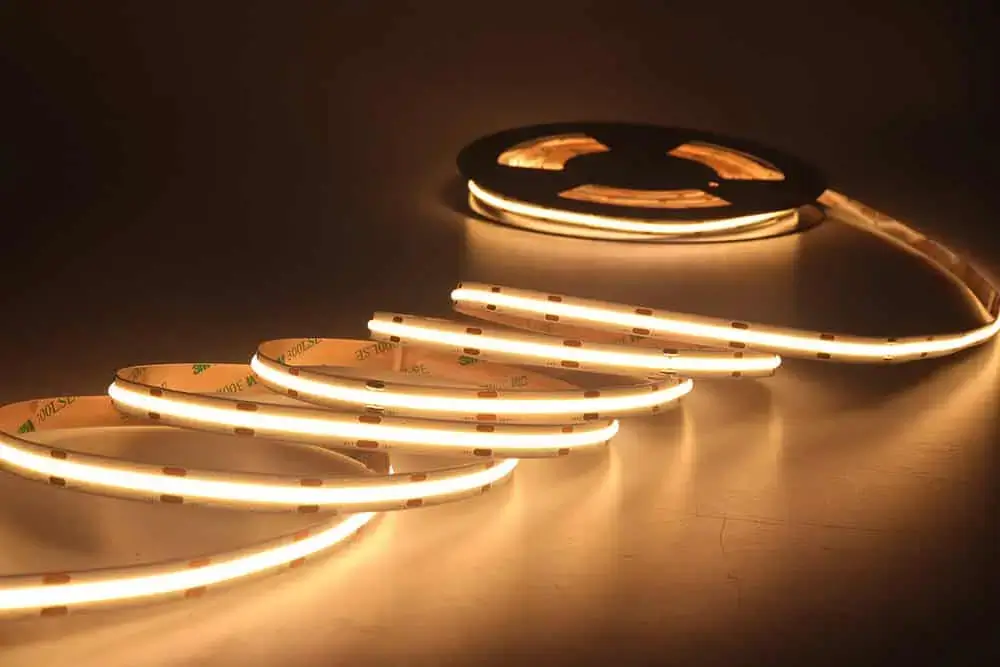
48V is the newest mainstream option, built for one job: long continuous runs with minimal voltage drop. At the same wattage it carries one quarter of the current of a 12V system, so a single feed can drive 15–20 m of constant-voltage strip — and 30–50 m or more with constant-current ICs on the PCB.
15–20 m+ per feed (CV)
Standard 48V strips run far longer than 12V/24V without visible dimming.
30–50 m+ (constant current)
CC-on-PCB 48V strips stay uniform over very long runs from a single end feed.
Fewer drivers, less wiring
One driver replaces several; injection points mostly disappear.
Architectural scale
Facades, long coves, corridors, tunnels, warehouse aisles and linear neon runs.
Am besten für: building facades, long corridor coves, outdoor architectural accents, commercial signage and linear neon installations. Watch the trade-offs: cutting intervals are long (100–200 mm) and compatible drivers/controllers are less common than for 24V. For facade-scale planning, see our LED facade lighting guide.
5. 12V vs 24V vs 48V: Side-by-Side Comparison
Here is the honest, spec-level comparison. Maximum run lengths assume standard constant-voltage installation without power injection.
| Criterion | 12V | 24V | 48V |
|---|---|---|---|
| ~5 m (16 ft) | ~10 m (33 ft) | 15–20 m (50–65 ft) | |
| — | ~15 m (some CC types) | 30–50 m (100–160 ft)+ | |
| 25–50 mm | 50–100 mm | 100–200 mm | |
| Baseline | Half of 12V | Quarter of 12V | |
| High over 5 m+ | Moderate over 10 m+ | Low up to 20 m | |
| 4.8–14.4 W/m | 7.2–19.2 W/m | 10–20 W/m | |
| Very large | Large | Growing, fewer options | |
| 12V systems direct | Needs converter for 12V | Needs converter for 12V | |
| Lowest | Moderate | Highest per metre | |
| DIY, furniture, automotive | Commercial, hotel, office | Facades, long runs, architecture |
Two earlier KayTai guides cover the 12V vs 24V comparison in depth — 12V vs 24V: which is best Und choosing between DC12V and DC24V. This guide extends the same logic to 48V and the full decision framework below.
6. Constant Voltage vs Constant Current
Beyond the voltage number, the strip’s drive topology decides how far it can realistically go.
| Besonderheit | Constant voltage (CV) | Constant current (CC) |
|---|---|---|
| Fixed DC input (12/24/48V); resistors or linear ICs set current per group | Micro-current-regulating ICs on the PCB feed each LED group a constant current | |
| Fades beyond max length — needs power injection | Holds uniform brightness; designed for 15–50 m+ runs | |
| Simpler, more familiar, wide controller choice | Slightly more specialist, fewer dimmers/controllers | |
| 12V / 24V / 48V | 24V / 36V / 48V | |
| Most indoor projects | Long coves, facades, corridors, linear neon |
For architectural and long-run work, CC-on-PCB 48V strips are the modern answer: uniform brightness end to end, single-end feed, minimal wiring. If your project is pushing past 15 m, this is the technology to evaluate first.
7. Voltage Drop: Why the Far End Gets Dim
Voltage drop is the slow loss of voltage along copper traces as current flows. Every metre of strip adds a little resistance, so the far end receives less than its rated voltage — and LEDs dim, and in RGB strips colours shift toward the blue channel first.
Here is the practical rule: on a 12V strip, a drop of ~1.5V at the far end can cut output by roughly half; the same loss on a 24V or 48V system is a much smaller percentage of the supply, so brightness barely changes. That is why doubling voltage is the single most effective fix for dim ends.
Diagnose it
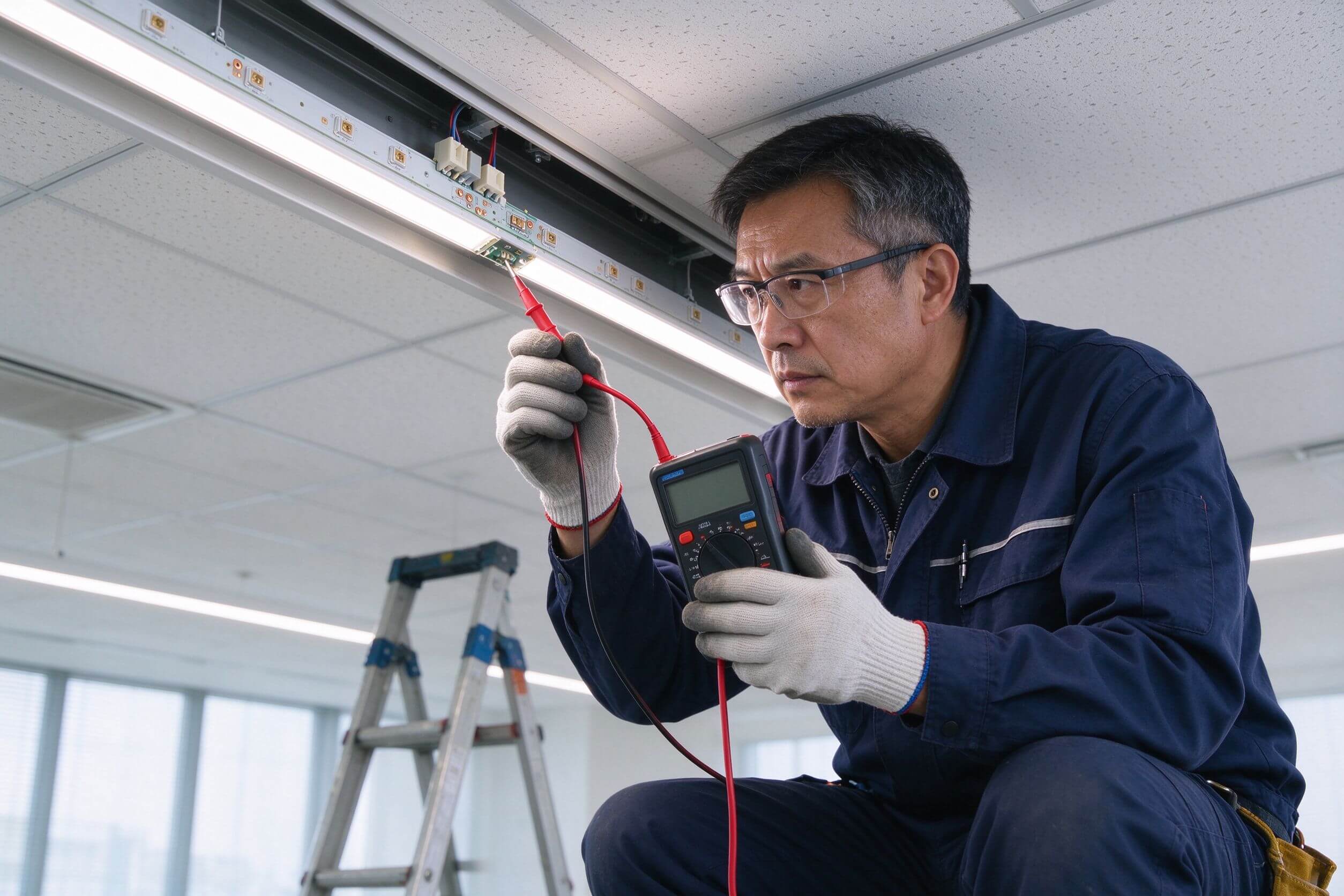
Multimeter at the far end: 12V strip below ~10.5V, or 24V below ~21V, means the run is too long for the voltage.
Feed both ends
Powering both ends cuts the worst-case drop by ~75% — the cheapest first fix.
Inject at midpoint
Add a power feed halfway for 24V/48V runs; use proper gauge feed wire (18–14 AWG).
Or step up the voltage
Swap to 24V for ~10 m runs, 48V for 15–20 m+, or choose a CC strip for very long runs.
For the full toolkit — dual-end feeding, midpoint injection, wire gauges and calculations — see how to avoid LED strip voltage drop und die power injection guide. You can also size wire and runs instantly with the KayTai voltage drop calculator.
8. How to Choose: Application-Based Guide
Stop choosing voltage by habit — choose it by run length and application. This table is the fastest practical reference:
| Your project | Recommended voltage | Warum |
|---|---|---|
| 12V (or 24V if long run) | Short runs, frequent cutting, 12V battery-friendly | |
| 12V | Direct 12V battery compatibility | |
| 24V | ~10 m uniform runs, DALI/DMX dimming | |
| 24V or 48V | 24V to 15 m; 48V beyond for fewer feeds | |
| 48V (CV or CC) | 15–50 m runs, minimal wiring, few drivers | |
| 48V (CC) | Long dot-free runs from single-end feed |
Quick decision rule: runs under 5 m → 12V; 5–10 m → 24V; 10–20 m → 24V with injection or 48V; beyond 20 m → 48V constant current. Need help estimating wattage for your layout? Use the KayTai power calculator before you buy a driver.
9. Power Supply Sizing and Wiring
Whatever voltage you choose, the driver must match it exactly and be sized with headroom. A 12V strip on a 24V supply burns out instantly; an undersized driver runs hot and trips.
Calculate total wattage
Watts per metre × total length = base load. Example: 12 W/m × 10 m = 120 W.
Add 20–30% headroom
120 W × 1.25 = 150 W minimum driver rating. Headroom keeps the driver cool and reliable.
Match voltage exactly
12V strip + 12V driver; 24V + 24V; 48V + 48V. Never mix — the LEDs will not survive.
Use proper gauge feed wire
18 AWG up to ~5 m, 14 AWG for longer feeds. Thin wire adds voltage drop before the strip even starts.

For complete power supply selection, wiring diagrams and the 20–30% headroom rule in detail, see the LED power supply guide. If energy cost matters, 24V systems also deliver measurable efficiency gains — see energy-efficient 24V systems.
10. Mistakes to Avoid
12V strips on long runs
Using 12V beyond 5 m without injection causes visible dimming. Step up to 24V or 48V first.
Voltage mismatch
12V strip + 24V supply, or 24V strip + 12V supply — instant LED burnout. Always match.
Skipping drop calculations
For runs over the rated max length, calculate voltage drop before buying, not after dimming appears.
Undersized drivers
A driver at 100% load runs hot and fails early. Keep 20–30% headroom.
Cutting anywhere
Cut only at marked copper pads. A wrong cut severs the circuit and kills the segment.
Thin feed wire on 48V systems
Long 48V runs still need proper gauge wire — current is lower, but distance multiplies resistance.
11. KayTai Solutions for Every Voltage
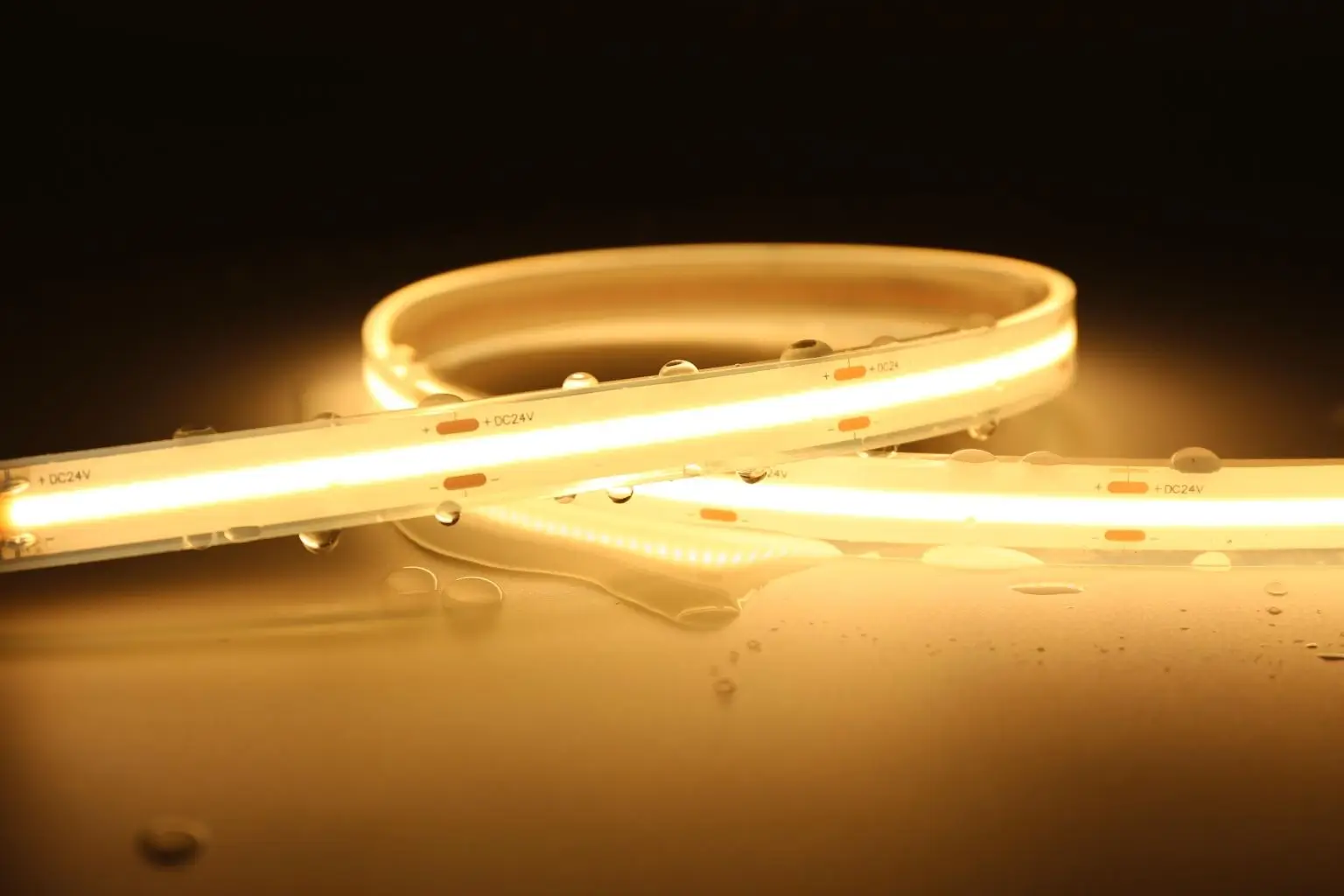
KayTai manufactures LED strip lighting, aluminum profiles and supporting components for both DIY and architectural projects. Our standard range covers 12V and 24V systems; 48V constant-current and long-run options are available for commercial and OEM projects — custom voltage, PCB width, density, CCT and waterproofing can be specified with our engineers.

Unsure which voltage fits your project? Contact KayTai with your run length, application and wattage — our engineers will recommend the voltage, driver and wiring plan, including custom 48V constant-current builds.
12. FAQ
▶Can I power a 12V LED strip with a 24V power supply?
No. Supplying more voltage than the strip is rated for overdrives the LEDs and burns them out, often instantly. Always match the strip voltage to the power supply voltage — 12V strip with 12V driver, 24V with 24V, 48V with 48V.
▶Which voltage is best for outdoor LED strip lighting?
24V or 48V. Outdoor architectural and facade runs are long, and higher voltage minimises voltage drop and reduces the number of power feeds needed. 48V is preferred for runs beyond ~15–20 m.
▶What is the maximum run length for each voltage?
As a guide without power injection: 12V ~5 m, 24V ~10 m, 48V ~15–20 m. Longer runs need power injection, dual-end feeding, or a constant-current strip. With CC-on-PCB 48V strips, runs of 30–50 m from a single feed are achievable.
▶Does higher voltage make LED strips brighter?
No. Brightness is set by LED type, density (LEDs per metre) and wattage, not by voltage. Voltage mainly determines how far you can run the strip and how uniformly it stays lit.
▶Are 48V LED strips safer than 12V?
Both are low-voltage DC and far safer than mains voltage. 48V remains below the extra-low voltage threshold in most regulations, but the current and energy available are higher — use quality drivers, correct wire gauge and follow local installation codes.
▶Why do my 12V strips dim halfway?
Voltage drop. The copper traces lose voltage over distance; beyond ~5 m the far end receives too little voltage to run at full brightness. Fix it with a 24V system, power injection, dual-end feeding, or shorter runs.
▶What is a constant-current 48V LED strip?
A 48V strip with current-regulating ICs on the PCB that feed each LED group a constant current. It holds uniform brightness over very long runs (30–50 m+) and is the standard choice for architectural and facade installations.
▶Can I connect multiple LED strips to one power supply?
Yes, if the total wattage stays within the driver rating (with 20–30% headroom) and you wire in parallel, not in a single over-long chain. For multi-strip wiring detail, see the LED power supply guide.
Not Sure Which Voltage Your Project Needs?
Send KayTai your run length, application and total wattage. Our engineers will recommend the right voltage system, driver size and wiring plan — including custom 48V constant-current builds for long-run projects.
Kontaktieren Sie KayTai