
Sommario
- 12V vs 24V at a glance
- 12VDC LED strip with shorter cut length
- RGB COB LED STRIP LIGHT
- RGBW COB LED STRIP LIGHT
- STRISCIA LED COB BIANCA TUNING
- STRISCIA LED COB DI COLORE BIANCO
- 12V LED strip has a wider range of application scenarios
- 24V LED strip, longer linear run
- 24V LED strip can be higher efficiency
- 24V LED strip requires less conductor gauge
- Conclusion: which one should you choose?
LED light strips are now found in many places in our homes. From refrigerators to under-cabinet lighting, they illuminate the areas where a full recessed fixture just isn’t feasible, or necessary.
But before you buy your next LED strip light, it’s a good idea to understand the differences between the two most popular voltages: 12VDC and 24VDC. This will ensure you get the right type of LED strip light for your particular project.
KayTai is a professional LED strip light factory. The difference between a 12VDC LED strip and a 24VDC LED strip is not too big, as long as you choose the correct power supply.
Choose 12VDC if…
You need a shorter cut length. For the same number of LEDs, the cut length of a 12VDC strip is half that of a 24V strip — giving you more flexibility to cut the strip exactly to the length you want.
Choose 24VDC if…
You need a longer linear run and higher luminous efficiency. 24V strips handle voltage drop far better and are ideal for whole-room or commercial projects.
12V vs 24V at a glance
Still not sure which one to pick? Here is a quick side-by-side summary of everything we compare in this guide:
| 12VDC LED strip | 24VDC LED strip | |
|---|---|---|
| LEDs per cut group | 3 LEDs | 6–8 LEDs |
| Cut length | Shorter — more flexible | Longer |
| Voltage drop on long runs | More noticeable | Reduced by about half |
| Current at the same power (e.g. 48W) | 4A | 2A |
| Power wasted on resistors | ~25% | ~12.5% |
| Conductor gauge required | Thicker | Half the copper |
| Best suited for | Short runs, corners, vehicles | Long runs, whole rooms, commercial |
Following article we will let you know more about LED strip lights.
12VDC LED strip with shorter cut length
Most individual LED chips run on 3VDC power — regardless of whether they are mounted on a 12V strip or a 24V strip.
In fact, the same LED chip that works on a 12V strip could also be mounted on a 24V strip. What makes the difference is how the strip circuitry is designed.
LED strips are wired in groups of LEDs. The size of the group depends on the voltage of the strip:
- 12V strip: 3 LEDs per group → closer cut lines, more flexibility
- 24V strip: 6, 7 or even 8 LEDs per group → longer cut lines
The cut lines are located between the groups. Therefore, the smaller each group of LEDs, the closer together the cut lines can be.
For example, see the diagrams of 12V and 24V strips below:
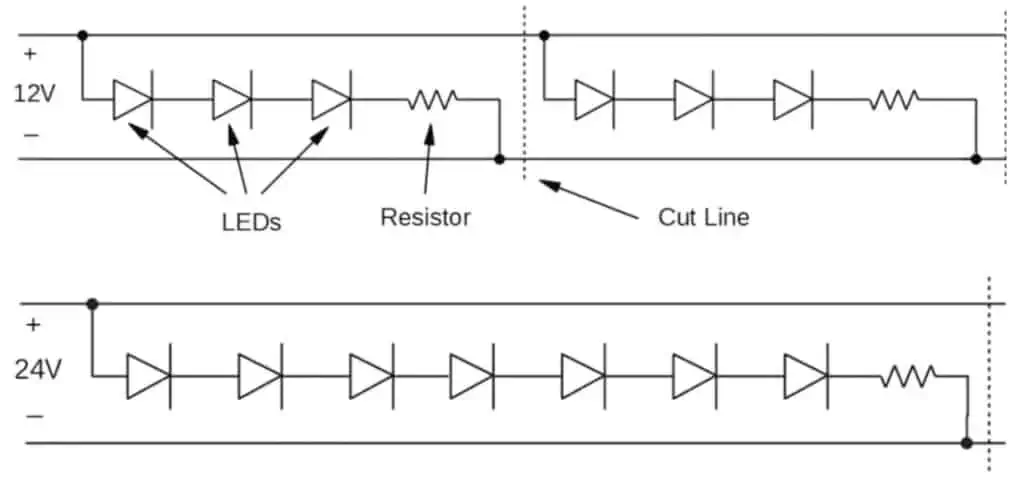
A lower voltage 12VDC strip with closer cut lines may be good if your installation has many corners with short lengths. This can help to minimize the “dark” zone at the corners.
Pro tip: To get the advantage of the long run of a 24VDC LED strip and the shorter cutting length of a 5VDC LED strip, we have developed Mini Cutting LED Strip — 1 LED per cut at 24VDC.
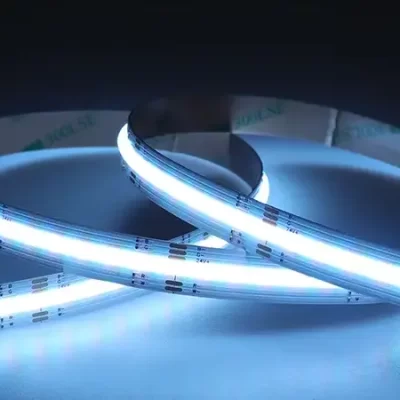
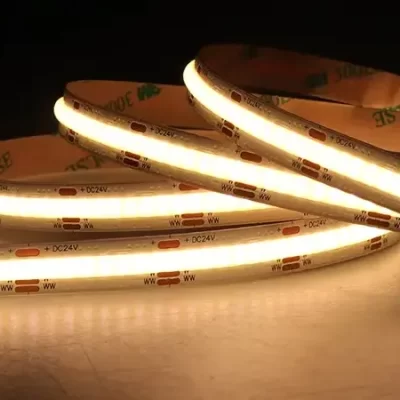
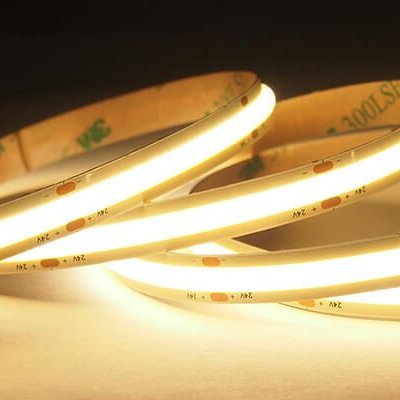
KayTai offers professional DC12V LED strip lights — feel free to browse the full range.

12V LED strip has a wider range of application scenarios
On the other hand, 12VDC is a common voltage, so LED strip compatibility may eliminate the need for additional power supplies.
Example: If you are installing lights in a vehicle, a 12VDC LED strip light can often be directly connected to the existing electrical system.
There are certainly exceptions to this — always check your existing system before making a purchase.
In many cases, however, 12V LED strips offer a more convenient installation solution.


24V LED strip, longer linear run
A higher voltage strip will generally be able to have longer runs without suffering from the effects of caduta di tensione.
What is voltage drop?
Voltage drop causes LED strips to lose their intensity as they become longer.
Beginning of the strip
Nearest the power supply — LEDs shine brightly.
End of the strip
Farthest from the power supply — LEDs have a dimmed appearance.
Why does voltage drop happen?
How voltage drop happens, step by step:
Any length of wire has a certain amount of electrical resistance.
The longer the wire, the bigger the resistance.
Bigger resistance causes a bigger voltage drop.
Eventually the LEDs begin to dim.
So LEDs at the end of a strip always get less voltage than the ones at the beginning.
Make the strip long enough, and the voltage drop becomes significant enough to cause a visible difference in brightness.
How does higher voltage reduce the effects of voltage drop?
First, you have to understand how all the components on an LED strip are connected.
How it works: Most individual LED chips run on 3V DC power, regardless of whether they are mounted on a 12V strip or a 24V strip.
LED chips are wired in series into groups. Each group contains some LED chips and a resistor. The total voltage drop across the group equals the total voltage of the strip (see diagrams below).
In fact, the same LED chip that works on a 12V strip could also be mounted on a 24V strip. What makes the difference is how the strip circuitry is designed.
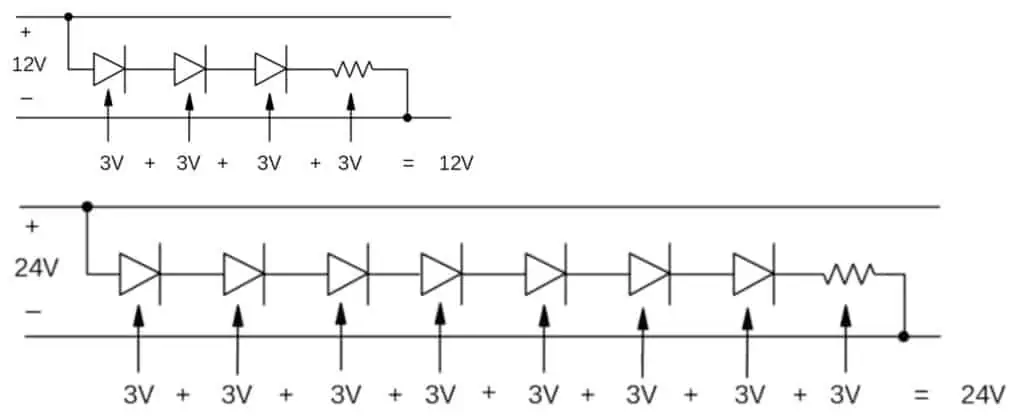
Then, each group is wired in parallel and arranged along the length of the strip.
12V LED strip
3
LEDs per cut group
24V LED strip
7
LEDs per cut group
Take notice in the diagrams above: the group size on a 24V strip is 7 LEDs compared to only 3 LEDs for 12V. We will explain why this is significant below.
Keep in mind: Every wire has a certain amount of resistance. The longer the wire, the bigger the resistance — and the bigger the voltage drop.
Eventually it gets large enough to impact LED brightness. Below is an example of how this happens on a 12V strip.
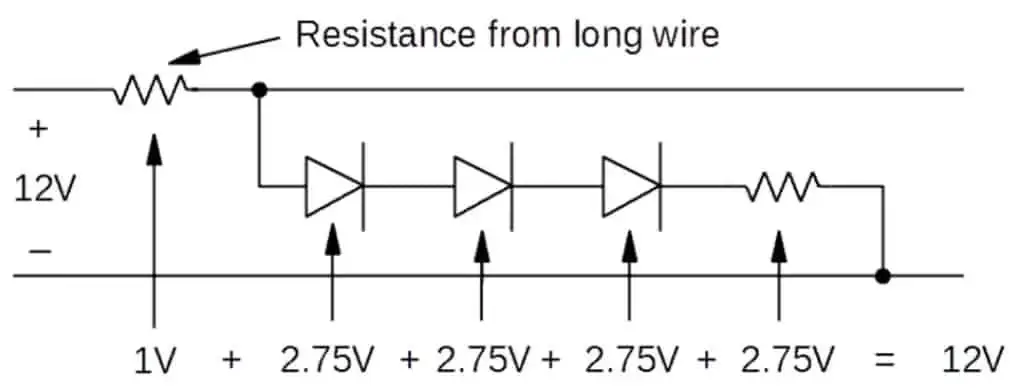
Notice in the above diagram that the voltage across the LEDs has dropped from 3.0V to 2.75V.
When we switch to 24V, two things happen that reduce the voltage drop:
- 1Current is halved. When the voltage gets doubled (12V to 24V), the current is halved (Ohm’s law P = U × I). That causes the voltage drop from the long wire to be reduced by half as well — so instead of a 1V drop, it becomes a 0.5V drop.
- 2The drop is spread across more components. The effect of the 0.5V drop is split between the eight remaining circuit components (compared to 4 on the 12V).

Notice here that the voltage across the LEDs has only dropped to 2.9375V compared to 2.75V with the 12V strip.
When should you choose 24V? If your application needs long runs of strips, 24V is the way to go.
But even 24V strips have a limit. To stop LEDs from fading at the end, use techniques like our Super Long Constant Current LED Strips.
24V LED strip can be higher efficiency
Higher voltage can be more efficient.
Any time there is voltage across a resistor, energy is converted to heat instead of light.
So the resistors in the diagrams above are necessary — but they are also a source of wasted energy.
The table below compares how much power is “wasted” on resistors at each voltage:
| Total voltage of strip | Voltage across resistor | % Power “wasted” on resistors |
|---|---|---|
| 5V (1 LED per group) | 2V | 40% |
| 12V (3 LEDs per group) | 3V | 25% |
| 24V (7 LEDs per group) | 3V | 12.5% |
It’s easy to see that higher voltage strips waste less energy.
LEDs use so little energy that this barely matters for small installations.
But the difference becomes significant for whole-room or commercial installations.
KayTai high-efficiency strips: We have developed high-efficiency LED strips — 8 LEDs per cut, up to 190 lm/W.
This is the same principle as high-voltage power transmission: the higher the voltage, the smaller the current.
According to Ohm’s law, the voltage drop Vdrop = I × R, and the electrical energy converted to heat is P = U × I = (I × R) × I = I² × R.
24V LED strip requires less conductor gauge
Electrical power is determined by the equation P = V × I. To maintain the same power (P), if voltage (V) goes up, current (I) must come down by a proportional amount.
Example: If we keep 48W as our target output as a concrete example, a 12V system will require 4 Amps (12V × 4A = 48W), while a 24V system will only require 2 Amps (24V × 2A = 48W).
Simply put, a 24V LED system will draw half the amount of current as a 12V LED system to achieve the same power level.
Why is this important?
Total current, rather than voltage, determines the thickness and width of copper conductors needed to transfer power safely.
Watch out: If too much current is forced through a small or narrow copper conductor, resistance inside it becomes significant — contributing to voltage drop and heat generation.
In very extreme cases, this can even lead to electrical fires.
Good news: All else equal, a 24V LED system needs only half of the electrical conductor requirements.
You can use the voltage drop calculator to make sure you are still using sufficient conductor gauges for your LED strip projects.
Smaller power supplies for 24V LED strip
Like conductor size, power supply size is determined primarily by current rather than voltage.
Much of a power supply unit’s internal wiring is copper, so the same physics applies — less current means a smaller supply.
12V system
Draws more current — needs a larger power supply.
24V system
Draws less current — allows a smaller, more compact power supply.
Power supply size can be important when working with projects such as LED strip lights in under cabinet installations where there may be space constraints.
Conclusion: which one should you choose?
Given the information from these 12V vs 24V LED strip light comparisons, we can see that both of them have their own merits to count on:
- ✓12V LED strips — if you are going to use it inside your room, you may have better results with 12V lighting strips;
- ✓24V LED strips — if you are willing to invest more money for more power, then you may go for 24V lighting strips.
It all comes down to your individual needs and financial status. KayTai is the one you can trust! Welcome here.
Need help choosing between 12V and 24V?
Tell us about your project — our engineers will help you pick the right voltage, length and power supply for free.
Guide LED correlate

Clear comparison of 12V and 24V systems. The voltage drop and efficiency trade-offs are explained simply. Helped me decide which voltage to use for my runs.
Clear comparison of 12V and 24V. Voltage drop and efficiency trade-offs are explained simply. Helped me decide for my runs.