
Have you ever looked closely at an LED strip and wondered what is actually inside? It looks simple — a thin flexible tape with tiny dots of light. But behind that tape is a precision-built circuit board with real engineering.
In this guide, we break down the construction of an LED strip — the components, the PCB, the circuit design, and the manufacturing process — so you understand exactly what you are buying.
01 Anatomy of an LED Strip
A typical LED strip is built from six core components working together:
The Light Source
Surface-mount LEDs (SMD) or chip-on-board (COB) that emit the light. Chip brand and binning decide quality.
The Circuit Board
A flexible printed circuit board that carries power and connects all components. The backbone of the strip.
Current Control
Small resistors that limit current to each LED group, protecting them and keeping brightness stable.
Stability
Components that smooth voltage and reduce flicker in the circuit.
The Wires
Thin copper traces printed on the PCB that carry current along the strip. Wider copper means less voltage drop.
The Install
3M adhesive (and sometimes a removable liner) that lets you stick the strip onto almost any clean surface.
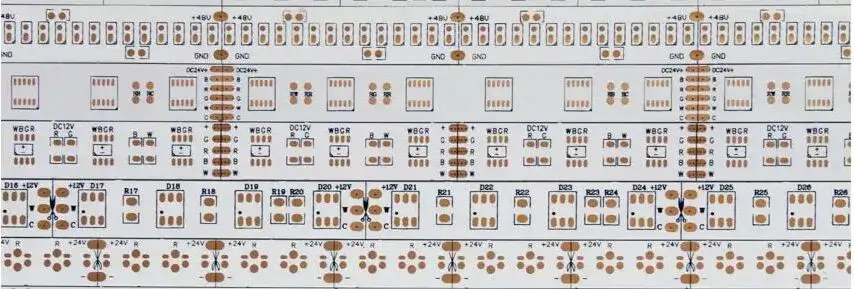
More Than Meets the Eye
The components you can see — the LEDs — are only part of the story. The circuit design and copper quality hidden in the PCB determine whether your strip runs bright, stable, and long.
Learn about chip quality in our guide to SMD LEDs a COB strips.
02 The PCB: The Backbone of the Strip
The printed circuit board (PCB) is what makes a strip a strip. It is a flexible layer of copper foil and insulating material that connects every component with printed circuit traces.
How a Flexible PCB Is Built
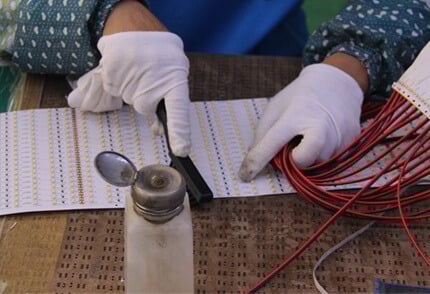
Copper quality and width matter enormously: thicker, wider copper carries more current with less voltage drop, keeping the far end of a long run as bright as the start.
03 How the Circuit Works: Series vs Parallel
Inside the strip, LEDs are arranged in two ways — series a parallel. Each has different behavior when things go wrong.
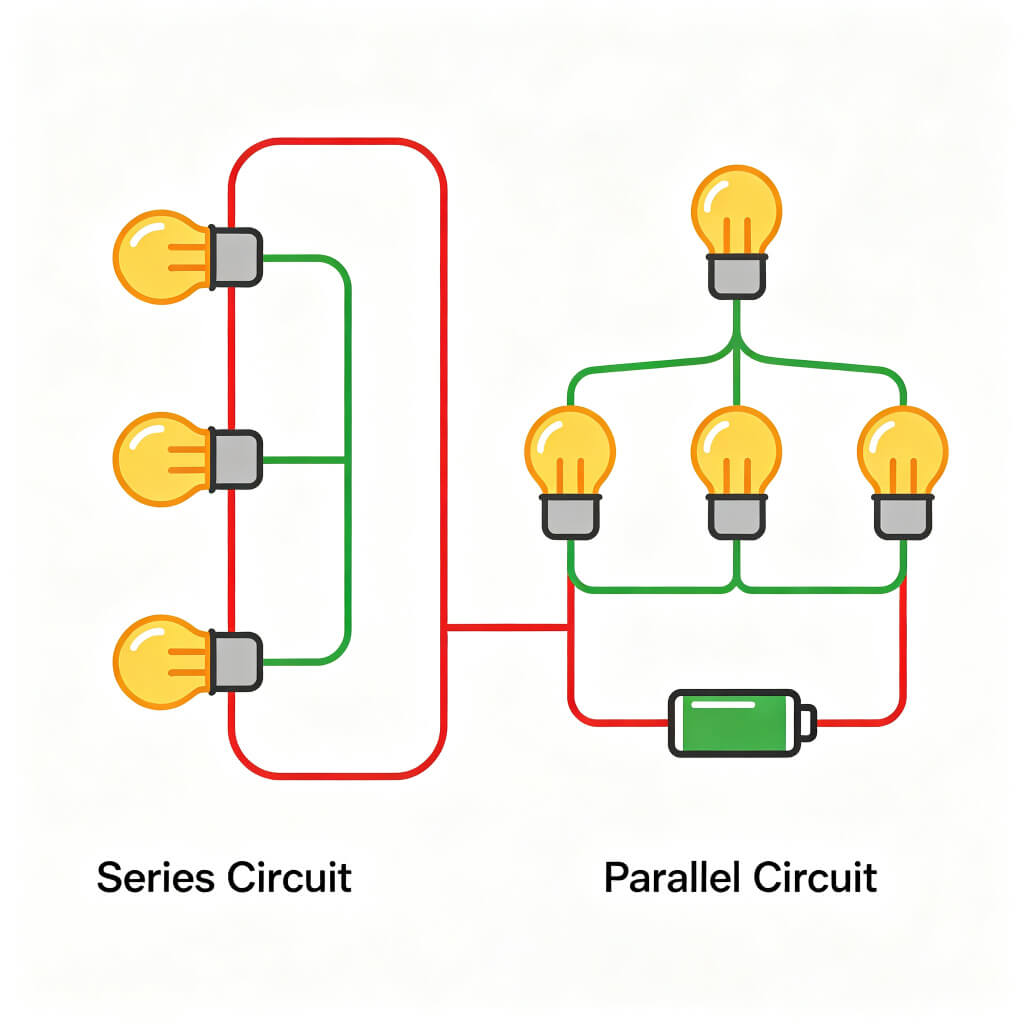
Series Circuit
LEDs are connected in a single loop. Current is equal in every LED, and voltage adds up (V = n × Vf). If one LED fails, the whole group goes dark.
Parallel Circuit
LEDs are connected across the same voltage. Each branch gets its own current. If one LED fails, the others keep working — this is the safer, more common design in quality strips.
| Funkcia | Series | Parallel |
|---|---|---|
| Current | Same in every LED | Divided per branch |
| Napätie | Adds up (V = n × Vf) | Same across all branches |
| If one LED fails | Whole group goes dark | Others keep working |
| Used in LED strips | Rare (groups only) | Standard design |
04 From Board to Finished Strip
Producing a quality LED strip is a precision process. Here is the journey inside a factory:


This full process is exactly how we build strips at KayTai. See it step by step in our guide to how LED strip lights are made, and our strict quality control system.
05 Why Construction Quality Matters
Two strips can look identical on the surface and be completely different inside. Here is what good construction delivers:
Consistent Brightness
Even light along the whole run — no dimming at the end.
Longer Life
Proper resistors and capacitors protect LEDs from current spikes.
Reliable Solder
Clean reflow soldering prevents dead sections and flicker.
True Color
Good binning means every meter matches the next.
How to Spot a Well-Built Strip
- Check the copper width on the cut points
- Look for clean, uniform solder joints
- Verify the LED brand and binning
- Confirm the CRI and SDCM specifications
- Buy from a manufacturer with full QC — not just a reseller
Browse our factory-direct LED pásy svetla a single-color strips.
06 LED Strip Construction FAQ
Q1Why do LED strips have resistors?
Resistors limit the current flowing to each group of LEDs. Without them, current spikes could overheat and burn out the chips, or cause uneven brightness.
Q2What is the difference between series and parallel LED strips?
Series connects LEDs in one loop (one failure kills the group); parallel connects them across the same voltage (one failure leaves the rest working). Quality strips use parallel design.
Q3Does the PCB affect brightness?
Yes. Wider copper traces carry more current with less voltage drop, keeping the far end of a long run bright. Thinner copper causes brightness to fade along the strip.
Q4How are LED chips attached to the strip?
Chips are placed by an SMT pick-and-place machine, then secured by reflow soldering — a process that melts solder paste to create strong, reliable connections.
Need Custom LED Strips?
Our factory supports custom PCB, chips, lengths, and packaging. Ask us for a quote.

Great explanation of how LED strips actually work. The description of the circuit layout and resistor function is simple enough for a beginner but accurate enough for an installer. The cutting explanation was especially clear.
Interesting read. I finally understand why the cut points matter and how the circuit design works. The diagrams would help anyone new to LED strips get started with confidence.
The PCB construction explanation is exactly what I needed to tell my customers why some strips fail at cut points. The copper layer diagram makes the current flow concept easy to understand. Solid technical article.