
At KayTai, we are proud to offer high-quality LED strip lights that meet the diverse needs of our clients in the U.S. One of the key technologies that power our LED strips is Surface-Mount Device (SMD) LEDs, known for their superior performance, flexibility, and efficiency. In this article, we will explore the different types of SMD LEDs used in LED strip lights, their advantages, and how they can be leveraged for various lighting applications. See also our COB vs SMD comparison.
Kazalo
1. What Is an SMD LED?
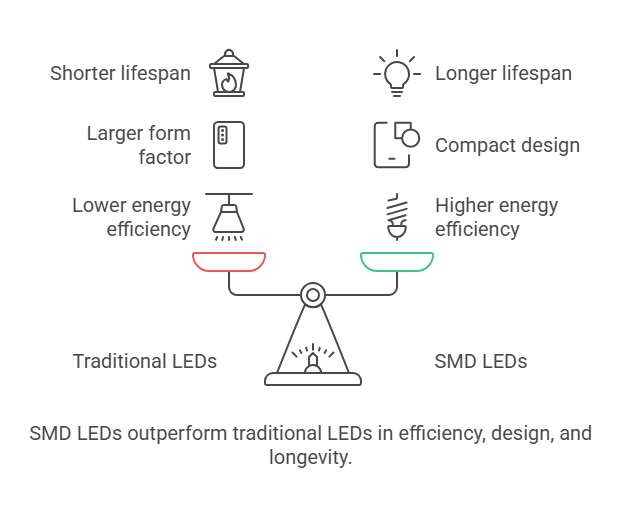
An SMD LED is a type of light-emitting diode (LED) that is mounted directly onto a surface, typically a PCB (Printed Circuit Board), rather than through-hole technology. SMD LEDs are known for their compact size, which allows them to be used in a wide range of applications. Compared to traditional LEDs, SMD LEDs are more energy-efficient, provide higher brightness, and are easier to integrate into modern designs due to their small form factor.
Higher Efficiency
They generate more light while consuming less power.
Compact Design
Ideal for flexible and thin LED strips.
Longer Lifespan
SMD LEDs are known for their durability and long operational life.
2. Common Types of SMD LEDs Used in LED Strip Lights
At KayTai, we offer several types of SMD LEDs that cater to different customer needs. Below are the most common types used in LED strip lights:
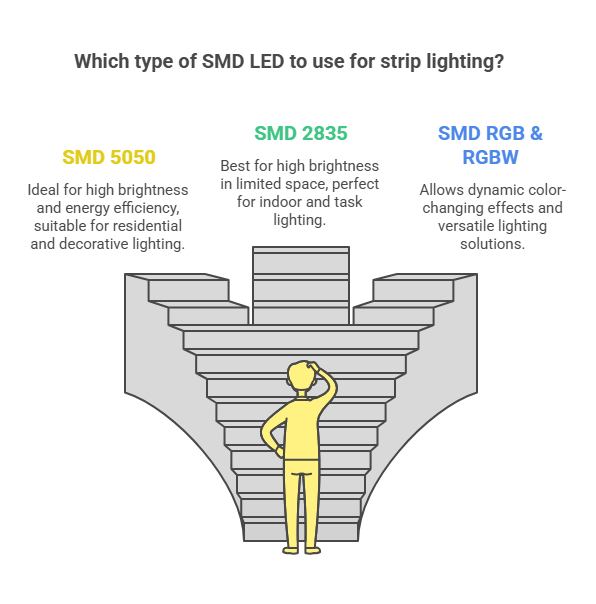
SMD 5050
One of the most widely used LED types for LED strips. It features a larger chip size (5.0mm x 5.0mm), ideal for applications requiring high brightness. Commonly used in both RGB and white lighting strips. Great for residential lighting, signage, and decorative applications.
SMD 2835
Smaller (2.8mm x 3.5mm), offering excellent energy efficiency with a higher luminous output. Popular for indoor lighting, task lighting, and backlighting due to uniform light output and reliability.
SMD RGB & RGBW
SMD RGB LEDs allow for dynamic, color-changing lighting effects, ideal for accent lighting, mood lighting, and architectural features. RGBW LEDs add a dedicated white channel for even more versatility.
3. SMD LED Sizes and Voltage
SMD LEDs come in various sizes, the most common being 3528, 5050, and 2835. The size of the SMD LED affects both the brightness and flexibility of the strip: 3528 — smaller (3.5mm x 2.8mm), typically used for low-power applications where minimal brightness is required, such as under-cabinet lighting or accent lighting; 5050 — larger, perfect for high-brightness applications, offering a greater light output per unit; 2835 — often chosen for applications requiring a balance between size and brightness, offering more light output per watt compared to 3528, ideal for general-purpose lighting. When selecting the appropriate size for your LED strips, consider the intended application and required brightness levels.

💡 Most SMD LED strips operate on either 12V or 24V systems. 12V SMD LEDs are the most commonly used for residential and smaller commercial applications, providing a good balance between power consumption and brightness. 24V SMD LEDs are more efficient for longer strips, as they can carry power over greater distances without significant voltage drop, ideal for larger installations. It’s important to match the correct voltage to your power supply to ensure optimal performance and safety. See Vodnik 12V proti 24V.
4. SMD LED vs COB LEDs
While both SMD LEDs and COB (Chip-on-Board) LEDs are used in lighting applications, they differ in how the chips are mounted. SMD LEDs are typically mounted one by one, while COB LEDs use multiple chips integrated onto a single board, offering higher intensity and a more uniform light source. SMD LEDs are more flexible and cost-effective for LED strip lights, while COB LEDs are generally used for applications requiring high-intensity lighting, such as high-output spotlights. For more on the differences, see COB vs SMD LED strip comparison.
SMD LEDs
Mounted one by one; more flexible and cost-effective for LED strip lights.
COB LEDs
Multiple chips integrated onto a single board; higher intensity and more uniform light, used for high-output applications.
💡 The dimensions of SMD LEDs not only determine their size but also impact their compatibility with various LED strip designs. Understanding the dimensions ensures that you select LED strips that will fit properly within your installation, whether it’s a narrow channel or a wide open space.
5. Practical Applications of SMD LEDs in LED Strip Lights
Residential Lighting
Under-cabinet lighting, accent lights, and mood lighting.
Commercial Lighting
Office spaces, retail environments, and hospitality.
Decorative Lighting
Architectural features, signage, and DIY projects.
Automotive Lighting
Interior lights, accent lighting, and exterior lighting.
Specialty Lighting
Backlighting for TVs, mirrors, and displays.
Zaključek
Understanding the different types of SMD LEDs, their sizes, and their applications can help you make an informed decision when selecting LED strip lights for your projects. At KayTai, we offer a wide range of SMD LED strips that cater to various needs, from high-brightness SMD 5050 LEDs to energy-efficient SMD 2835 strips, as well as dynamic RGB and RGBW options. If you’re looking for reliable, high-performance LED strips for your next project, we’re here to help. Explore our single-color LED strips in RGBW LED strips to find the right solution.
Choose the Right SMD LED Strip for Your Project
From SMD 5050 to 2835, KayTai supplies high-performance LED strips at factory-direct prices.
Kontaktirajte KayTai
SMD package sizes finally explained. The difference between 2835, 3528 and 5050 is easy to grasp. Useful background before buying strips.
Clear explanation of SMD LEDs and their package sizes. The difference between 2835, 3528 and 5050 is finally easy to understand. Useful background for anyone buying strips.