
Si vous souhaitez utiliser votre réglette LED avec un canal LED en aluminium, alors vous devez choisir le bon diffuseur LED profilé. Il existe de nombreux types de diffuseurs profilés LED sur le marché. Chaque modèle a ses propres avantages. Pour faciliter votre décision, nous examinerons ces modèles de plus près avec une explication détaillée de chaque fonctionnalité.
Dans ce guide, vous apprendrez :
- Comparaison des quatre principaux matériaux de diffusion (PVC, PMMA, PC, silicone)
- Ce pour quoi chaque finition de diffuseur – transparente, givrée, opale, laiteuse, noire, silicone et lentille – est la meilleure pour
- Si vous avez réellement besoin d'un diffuseur pour votre projet de bande LED
- Comment choisir le bon diffuseur pour votre application sans perdre trop de luminosité

1. Comparez les différents matériaux des diffuseurs LED
Les principaux matériaux du cache profilé LED sur le marché sont le PC, le PMMA, le silicone et le PVC. Les diffuseurs/couvercles profilés de différents matériaux jouent non seulement différents rôles anti-rayures, anti-extrusion et anti-vieillissement, mais ont également un impact sur l'effet de l'éclairage. Découvrons ici les avantages et les inconvénients de chaque matériau de revêtement de profil LED.

PVC
Il est assez résistant aux flammes et présente une rigidité, résistant aux alcalis et aux acides. Le prix du PVC est très bas, mais l'absorption de l'humidité et la résistance à la chaleur sont médiocres et il est très facile de jaunir après un certain temps d'utilisation, c'est pourquoi de moins en moins de techniciens choisissent le PVC comme abat-jour.
PMMA (Acrylique)
Il est dur et résistant aux rayures, présente une bonne transparence, isolation et résistance mécanique et est facile à traiter. Mais faible résistance chimique et peu résistante aux chocs.
PC
Il se caractérise par la plus grande résistance aux alcalis, aux acides et à l’essence. Il est ignifuge, résistant aux rayures et possède de très bonnes propriétés optiques. Cependant, il ne résiste pas à l’humidité – il deviendra cassant.
Silicone
Il est flexible, ignifuge, résistant aux frottements et très respectueux de l’environnement. Un diffuseur profilé en silicone est plus facile à installer, mais a une transmission lumineuse plus faible et un prix plus élevé qu'un PC. En tant qu'abat-jour, il est généralement utilisé pour l'extrusion circulaire d'aluminium.
Comparaison des matériaux en un coup d'œil
| Matériel | Points forts | Attention | Utilisation typique |
|---|---|---|---|
| PVC | Ignifuge, rigide, faible coût | Jaunit, mauvaise résistance à la chaleur et à l'humidité | Couvertures intérieures économiques |
| PMMA (Acrylique) | Dur, résistant aux rayures, transparent, facile à traiter | Faible résistance aux produits chimiques et aux chocs | Profils clairs et dépolis |
| PC | Ignifuge, résistant aux rayures, excellente optique | Devient cassant s’il n’est pas protégé contre l’humidité | La plupart des diffuseurs haut de gamme |
| Silicone | Flexible, ignifuge, écologique et facile à installer | Transmission inférieure, prix plus élevé | Profils circulaires / courbes |
2. Comparez les différents diffuseurs de profils LED
Différents diffuseurs profilés LED peuvent être utilisés à différentes fins. Par exemple, vous pouvez les utiliser pour éclairer une scène ou à des fins publicitaires. Vous pouvez également utiliser ce type de diffuseurs la nuit pour éclairer votre espace extérieur ou votre garage. Il existe différents types disponibles sur le marché, comme un diffuseur sans grille et un diffuseur circulaire qui produit une répartition uniforme de la source lumineuse.
Chacun des caches profilés ci-dessus joue son rôle dans l'éclairage LED qui n'est pas seulement l'apparence de l'installation elle-même lorsque l'éclairage est éteint mais chaque type diffuse la lumière de manière différente lorsque l'éclairage est allumé. Ci-dessous, nous comparons côte à côte les diffuseurs profilés LED les plus courants.

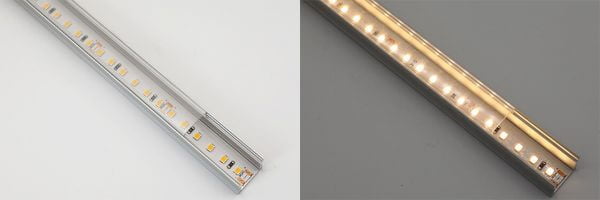
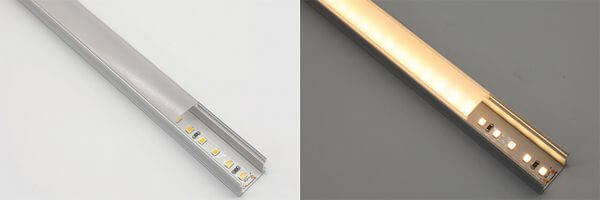

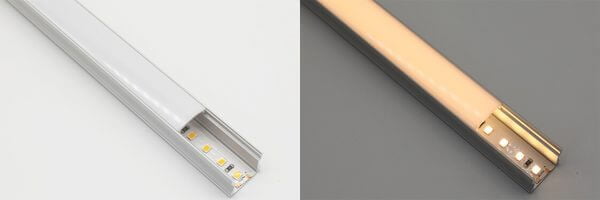


Types de diffuseurs en un coup d'oeil
| Taper | Transmission | Points chauds masqués | Idéal pour |
|---|---|---|---|
| Clair | ~90-95 % | Non | Éclairage indirect en corniche, luminosité maximale |
| Givré | ~85-90% | En partie | Éclairage de travail, sous l'armoire |
| Opale | ~75% | Oui | Vue directe, cuisines, commerces |
| Laiteux | ~65-70% | Oui, entièrement | Lumière décorative entièrement sans points |
| Noir | ~60% | Oui | Look premium et caché lorsqu'il est éteint |
| Silicium | ~70-75% | Oui | Profils courbes et circulaires |
| Lentille | N/A (focalise le faisceau) | Non | Effets de projecteur, faisceau 10-60° |
3. Avez-vous besoin d'un diffuseur pour votre bande lumineuse LED ?
Un diffuseur profilé LED diffus est simplement une feuille plate de plastique découpée de manière bien spécifique. La forme de la découpe laisse passer la lumière mais la dirige également de manière à créer une lueur douce et uniforme sur la surface d'un objet. Ce type de diffuseur de lumière peut être utilisé sur à peu près tout ce où vous souhaitez une sorte de lueur douce et uniforme – comme un bureau ou un comptoir de cuisine – mais il est particulièrement idéal pour une utilisation avec des lumières intérieures et un éclairage décoratif qui nécessite une sorte d’amélioration.
Lorsque vous cherchez à éclairer une pièce avec des lumières LED, il est important de réfléchir au type de lumière que vous souhaitez. Si vous recherchez une lueur douce et uniforme, l’éclairage diffus est la solution idéale.
L’éclairage diffus est le choix idéal pour la plupart des applications où vous n’avez pas besoin d’un projecteur lumineux. C’est également le meilleur choix pour éclairer uniformément de grandes surfaces et décorer des pièces sans surcharger les petits espaces comme les salles de bains ou les placards.
Si vous recherchez une lumière plus intense dans une zone spécifique, envisagez un panneau LED monté au-dessus ou en dessous du luminaire. Cela peut être utile si votre luminaire n’est pas assez haut pour atteindre suffisamment haut pour éclairer votre espace de travail ou l’espace mural en dessous.
Les diffuseurs sont le type de diffuseur de lumière le plus courant. Ils créent une source de lumière douce et uniforme qui est souvent utilisée dans les bureaux, les magasins de détail et autres espaces commerciaux.
Les diffuseurs peuvent être utilisés dans tout type d’application d’éclairage, y compris les luminaires encastrés et encastrés. La meilleure façon de diffuser la lumière est d’utiliser plusieurs couches de diffuseurs.
Le nombre de couches dépend de la taille et de la forme de votre luminaire, mais vous devez toujours utiliser au moins deux couches pour des résultats optimaux.

En avez-vous toujours besoin ? Une règle générale rapide
- Les installations à vue directe nécessitent un diffuseur : si le profil est dans votre champ de vision, utilisez de l'opale ou du lait pour masquer les points LED et réduire l'éblouissement.
- Les bandes COB sont déjà sans points : un Bande LED COB semble continu à lui seul, donc une couverture transparente ou dépolie suffit souvent – une couverture laiteuse ne coûte que de la luminosité.
- La lumière cachée/indirecte peut l’ignorer : pour l'éclairage d'une corniche ou derrière un déflecteur où la bande n'est jamais vue directement, un couvercle transparent maintient un rendement maximal.
- Éblouissement et fatigue oculaire : si vous ou vos clients regardez les lumières pendant des heures (bureaux, commerces, cuisines), un diffuseur est fortement recommandé pour protéger les yeux.
4. Guide rapide : Comment choisir le bon diffuseur
Adaptez votre application au diffuseur qui donne le look souhaité sans gaspiller la luminosité :
| Votre candidature | Diffuseur recommandé | Pourquoi |
|---|---|---|
| Lampe de travail sous l'armoire | Givré ou opale | Lumineux mais confortable pour les yeux, pas de points |
| Lumière linéaire visible (salon, chambre) | Opale ou laiteux | Ligne moderne et lisse, entièrement sans points |
| Plafonnier Cove / indirect | Clair | La bande est cachée, conserve une luminosité maximale |
| Look haut de gamme/caché lorsqu'il est éteint | Noir (fumée) | Invisible lorsqu'il est éteint, look architectural |
| Profils courbes ou circulaires | Silicium | Flexible, suit la courbe |
| Lavage mural d'accent / galerie | Lentille | Focalise le faisceau pour un effet de projecteur |
Si la luminosité compte le plus, choisissez le diffuseur le moins opaque qui cache toujours les points pour votre distance de visualisation. Si l'aspect sans points compte le plus, optez pour le lait ou l'opale et choisissez un ton légèrement plus brillant. bande LED monochrome pour compenser la perte de lumière.
Pour un guide d'installation complet, consultez notre Guide d'achat de profilés LED en aluminium. Si vous éclairez une cuisine, notre guide d'éclairage sous meuble de cuisine couvre les meilleures bandes pour ce travail, et une fois que vous avez votre diffuseur, vous pouvez suivre comment couper et connecter des bandes lumineuses LED pour l'installer proprement.
5. FAQ sur les diffuseurs LED
Des réponses rapides aux questions que les clients nous posent le plus sur les diffuseurs à bandes LED.
T1. Un diffuseur réduit-il la luminosité de la bande LED ?
Oui, tout diffuseur absorbe un peu de lumière. Une couverture transparente ne perd qu'environ 5 à 10 %, tandis qu'une couverture opale ou laiteuse peut perdre 25 à 35 %. Si vous avez besoin d'une luminosité spécifique, choisissez une bande plus lumineuse pour compenser.
- Clair : ~5-10 % de perte de lumière
- Givré : ~10-15 % de perte de lumière
- Opale/Laiteux : ~25-35 % de perte de lumière
Q2. Quel diffuseur donne un aspect totalement sans points ?
Les couvercles laiteux et opales cachent complètement les points LED. Le dépoli ne les cache que partiellement – cela dépend de l’espace entre la bande et le couvercle et de la densité LED de la bande.
- Milky : masque entièrement les points, sortie plus douce
- Opale : cache les points, garde plus de luminosité
- Dépoli : partiel – utiliser des bandes denses (120 LED/m)
Q3. Les bandes LED COB ont-elles besoin d'un diffuseur ?
Pas pour cacher des points – les bandes COB produisent déjà une ligne de lumière continue et sans points. Une couverture transparente ou dépolie suffit généralement, et elle conserve plus d'éclat qu'une couverture laiteuse.
- Les bandes COB sont déjà sans couture
- Clair/givré garde plus de luminosité
- Laiteux uniquement si vous souhaitez un éclat extra-doux
Q4. Quelle est la différence entre les diffuseurs opale et laiteux ?
Ils se ressemblent mais diffèrent par leur opacité. L'opale transmet environ 75 % de la lumière, le laiteux environ 65 à 70 %. Milky est plus opaque et cache les points un peu plus fortement, au prix d'une luminosité légèrement inférieure.
- Opale ~ 75 % de transmission
- Laiteux ~ 65-70 % de transmission
- Milky cache légèrement mieux les points
Q5. Un diffuseur peut-il être coupé à ma longueur ?
Oui. La plupart des diffuseurs profilés peuvent être coupés à longueur avec une scie à dents fines ou un couteau à inciser, ou votre fournisseur peut les prédécouper à des longueurs exactes pour un bord plus net.
- Couper avec une scie à dents fines ou une inciseur
- Les longueurs prédécoupées évitent les bords ébréchés
- Commandez des embouts pour finir les deux extrémités
6.Conclusion
Toute personne utilisant des profilés LED en aluminium doit les diffuser. Les lumières LED sont très lumineuses et peuvent provoquer une fatigue oculaire lorsque vous les regardez directement. Les diffuser d’une manière ou d’une autre (comme ce diffuseur) les rendra moins intenses, ce qui permettra de mieux regarder les lumières tout au long de la journée.
Le bon choix se résume généralement à deux questions : d’où la lumière est visible et de quelle luminosité vous avez besoin. Les installations visibles veulent de l'opale ou du lait ; les installations cachées peuvent utiliser clear ; les designs haut de gamme adorent la finition noire. Quel que soit votre choix, un diffuseur de qualité protège les yeux, cache les points et donne à toute installation de bande LED un aspect beaucoup plus professionnel.
Parcourez notre Profilé LED en aluminium gamme pour trouver des profils, des diffuseurs et des embouts adaptés à votre projet, ou contactez-nous et nous vous aiderons à spécifier les pièces adaptées à votre commande.
Besoin d'aide pour choisir un diffuseur ?
Dites-nous votre application, le type de bande et l’aspect souhaité – notre équipe vous recommandera le profil et le diffuseur appropriés et vous enverra un devis gratuit pour votre projet.

Le guide du diffuseur est très utile. La comparaison entre opale et clarté et l'explication de la propagation de la lumière sont claires. M'a aidé à choisir la bonne finition pour une installation en crique.
Le guide du diffuseur est très utile. L'opale par rapport au clair et la diffusion de la lumière sont expliquées clairement. M'a aidé à choisir la bonne finition pour une installation en crique.