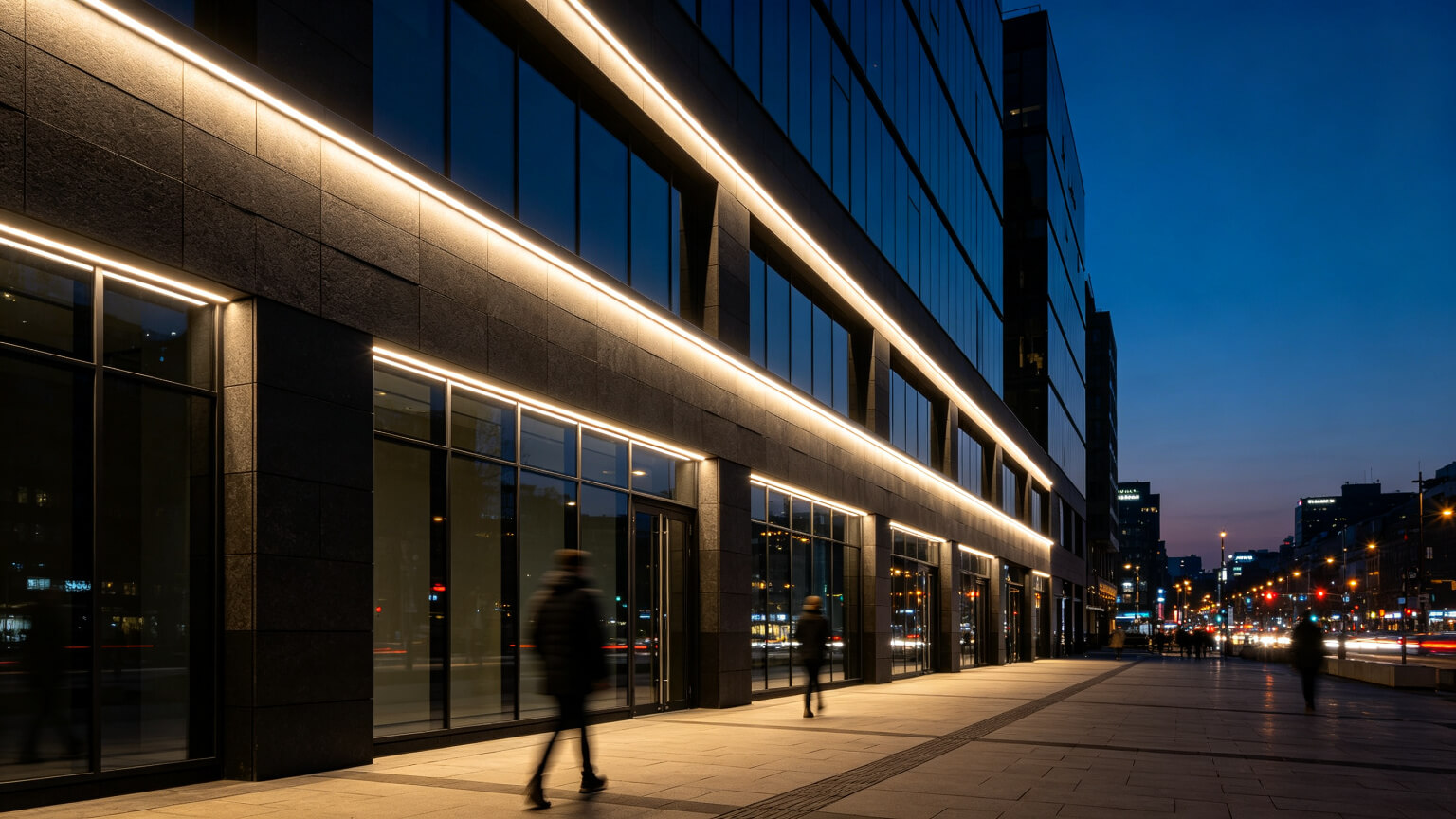
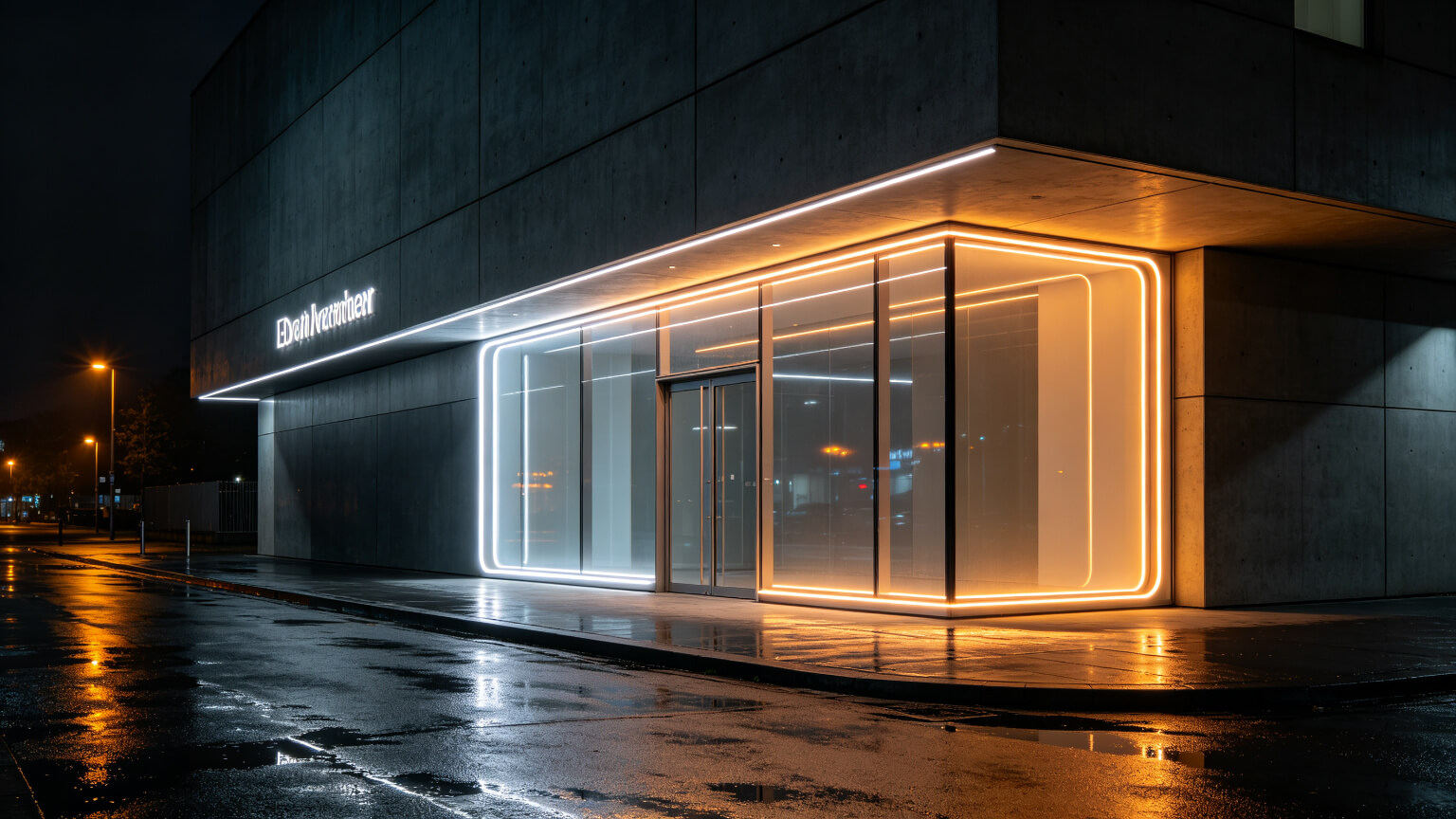
A facade is the first thing people see at night — and the last thing they remember. LED facade lighting traces a building with clean lines of light: safer perimeters, sharper CCTV, and a stronger brand image after dark.
This guide covers why facade lighting matters, how to choose between LED neon flex and LED linear light, and how to plan, install and control the system.
Table of Contents
Why Facade Lighting Matters
Good facade lighting solves real problems for owners, security teams and visitors — not just looks:
Clear Night Perimeter
Clean light lines trace the building edge, so staff and visitors always see where the building starts and ends.
Fewer CCTV Shadow Zones
Even light across walls and walkways removes dark corners where cameras go blind.
Brand Image & Wayfinding
Crisp, consistent lines look professional and guide people across large campuses at night.
Neon Flex vs Linear Light: Choose Your Tool
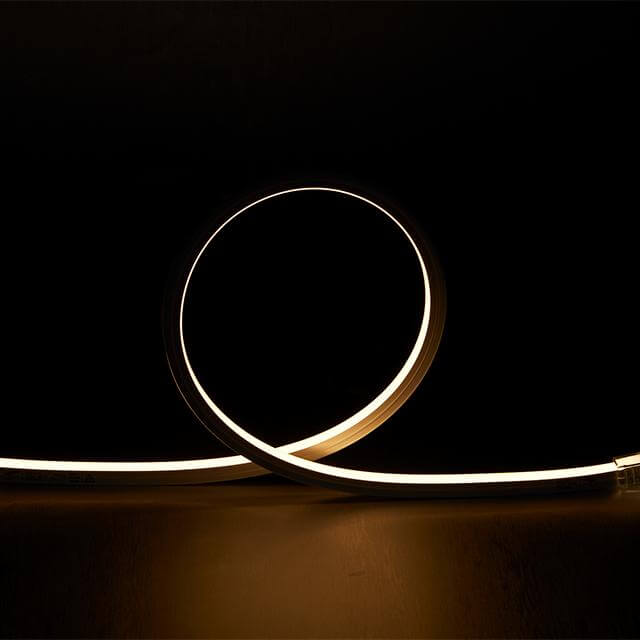
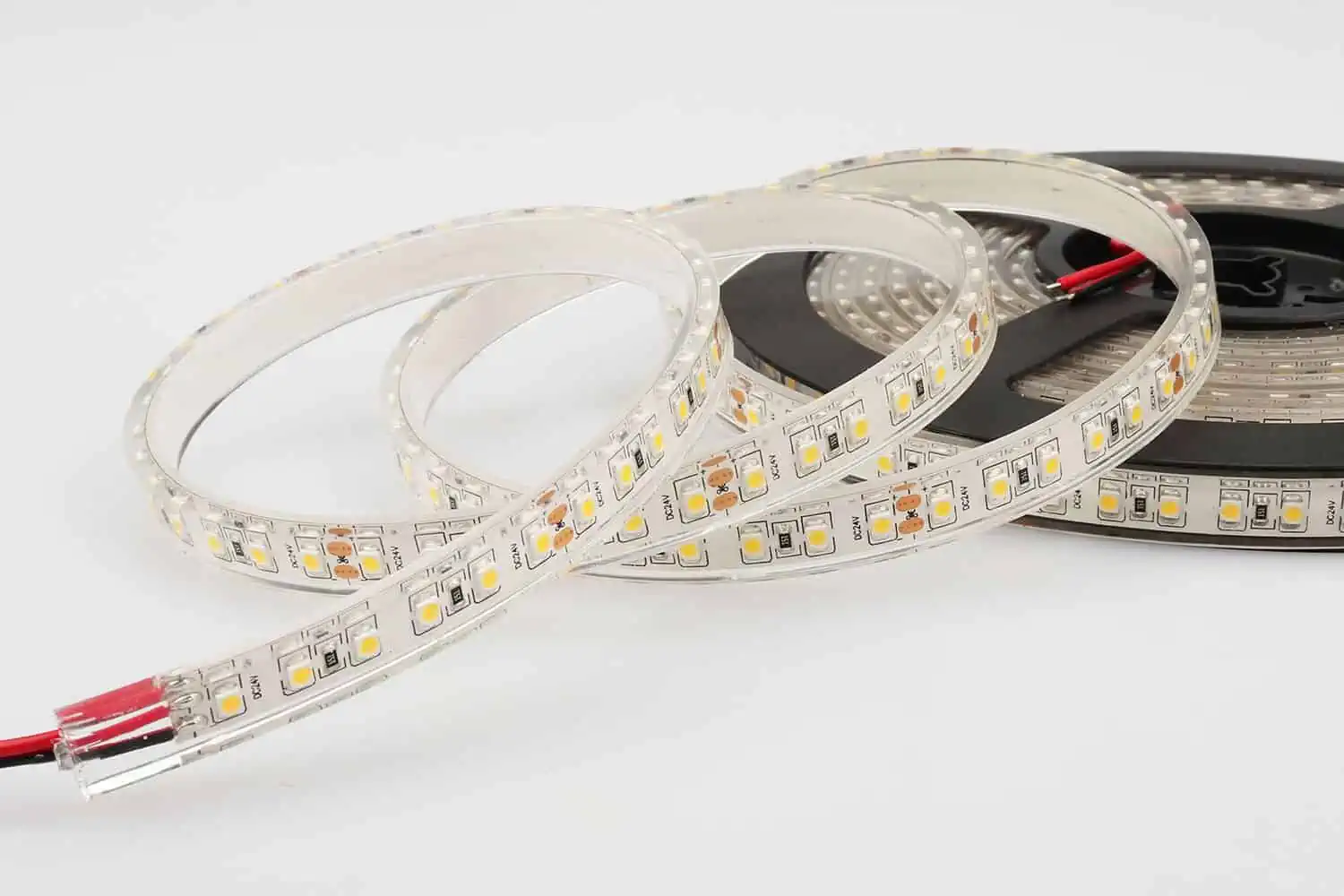
For facades, two KayTai products cover almost every design: LED neon flex for curves and outlines, and LED linear light for straight, even bands.
| Feature | LED Neon Flex | LED Linear Light |
|---|---|---|
| Shape | Bends and curves freely | Straight rigid lines |
| Best for | Building outlines, letters, arches, organic forms | Wall washing, mullion lines, cornice bands |
| Waterproofing | IP67/IP68 silicone tube | IP65+ sealed housings |
| Light character | Glowing neon tube look | Sharp, uniform optical line |
| Cutting | Cut at marked points | Modular lengths + joiners |
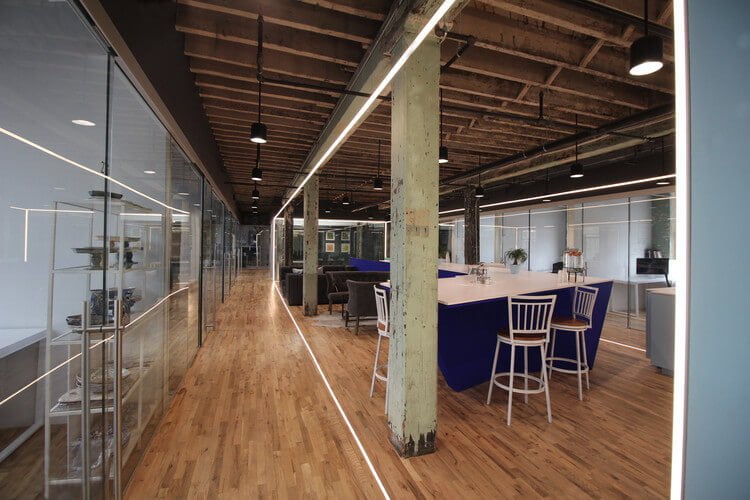
Want the full picture? Our LED neon flex vs glass neon comparison and the neon flex features guide cover both technologies in detail, while the LED linear lighting guide handles straight-run facade and interior designs.
Choosing the Right Fixture for Your Facade
Facades bring their own demands — height, weather, hard-to-reach mounts. Match the fixture to the surface first:
| Facade material | Fix & seal | Best product |
|---|---|---|
| Concrete / masonry | Anchors hold well; standard brackets | Any profile or neon flex channel |
| Metal panel / curtain wall | Flexes and carries heat; use clips or brackets | Lightweight neon flex with mounting clips |
| Glass / composite | Work with mullions, never the panel | Linear light on dedicated brackets |
Then choose the mounting: recessed fixtures sit flush in prepared channels (ideal for new builds), while surface-mounted units bolt onto the finished facade — the go-to for retrofits. Finally, match the IP rating to exposure: IP65 for sheltered walls, IP67/IP68 for open facades and ground level.
Planning the Design
Good facade lighting is not maximum brightness — it is the right amount, in the right colour, aimed correctly.
| Decision | Recommendation | Why |
|---|---|---|
| Brightness | A clear step above the background, never glaring | Light stone reflects and needs less; dark brick needs more |
| Colour temperature | 2700–3000K hospitality; 4000K offices & retail | Keep one CCT per facade for a uniform brand look |
| CRI | 80+ | Stone, wood and brick show their true tone |
| Glare control | Grazers, shielding, correct aiming | Light should illuminate the wall, never the viewer |
Installation & Weatherproofing
Design decisions mean little if the install is weak. Follow this sequence for a facade that lasts:
Measure & Pre-Fit
Dry-fit the full run on the ground; mark cut and corner points.
Fix the Track
Mount channels or clips level, with anchors matched to the facade material.
Route the Power
Hide cables inside channels or behind the fixture; seal every entry point.
Weatherproof All Joints
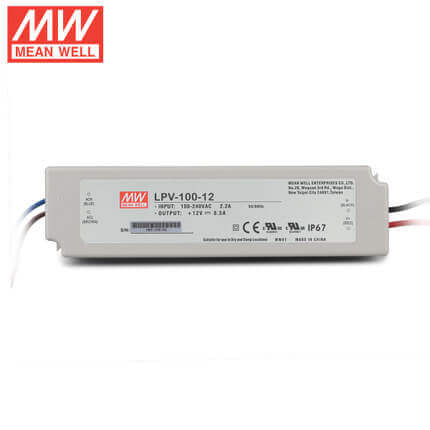
Seal end caps, connectors and driver boxes with IP67 glands.
Tamper-Proof the Reachable
Flush mounts and tamper-proof screws resist vandalism at ground level.
Test & Commission
Run the full circuit, check for dark segments and confirm dimming response.
Smart Controls & Building Automation
On larger buildings, facade lighting should talk to the rest of the system:
DALI / 0–10V Dimming
Address each fixture and tune brightness from one controller.
Scene Presets
A bright security mode, a soft night brand mode, and everything between.
Timers & Daylight Sensing
Switch on at dusk, trim at midnight, and skip hours the wall is already lit.
Building Integration
BACnet or KNX ties the facade into the building management system.
Common Mistakes to Avoid
- Over-lighting — a wall that glares looks flat and cheap; aim for contrast, not raw power.
- Mixed colour temperatures — different CCTs per span break the clean brand line; keep one per facade.
- Ignoring glare — fixtures in the line of sight blind visitors; use grazers, shielding and tight optics.
- Under-rated waterproofing — an open facade needs IP67/IP68; IP20 fails in the first rain season.
- Visible cables — exposed wiring ruins the effect and invites damage; hide every run.
- No surge protection — exterior runs need surge and lightning protection on the supply side.
Facade Lighting FAQs
▶What does a facade lighting project usually cost to run?
Running cost is small: LED neon flex and linear light use only a fraction of the power of floodlighting, and dimming at midnight cuts it further. Most of the budget is fixtures, drivers and installation — not electricity.
▶Do I need surge or lightning protection for exterior linear lighting?
Yes. Any exterior run should include surge protection on the supply side; buildings in lightning-prone regions need coordinated protection at the distribution board too.
▶How do I keep the whole facade looking uniform over time?
Buy tight colour binning, keep one CCT per facade, and size drivers with headroom (120–130%) so voltage drop never makes the far end dimmer or warmer.
▶When is the right time to retrofit an existing facade?
During any facade maintenance, repainting or rebranding window. Surface-mounted neon flex needs no structural work, so it is easy to add at any point.
▶Can neon flex be used for logos and lettering outdoors?
Yes. Neon flex bends into letters and logos and is available in IP67/IP68, so it is one of the most durable outdoor signage options — far tougher than glass neon.
Ready to Light Your Facade?
Send us your facade drawings and night-time photos — our factory team will recommend neon flex or linear light, plan the layout and quote the complete kit with free samples.
Contact KayTai
Comprehensive facade lighting guide. The section on LED neon flex for contour lighting is spot on — we used it on a hotel facade and the install tips here match our experience. The comparison with linear lights helped me decide between the two.
Great overview of facade lighting options. The IP rating advice for outdoor installations is practical. I especially liked the notes on mounting channels to keep the neon lines straight over long runs.
The section on mounting neon flex in concealed channels for facade contours answered a question we had on a hotel sign job. The bend radius guidance for corners saved us from ordering a profile that would have cracked under tension. Solid practical detail.